So you’ve just arrived to Bali fresh from the plane and you’ve found a place to stay and you need something to do – you’ve come to the right place. We’ve got both top tourist spots and your hidden gems.
1. Tanah lot
This is one of the biggest attractions on Bali with many people making the pilgrimage every day. Tanah lot is a row of waterside temples and astounding views. Picture worthy indeed and a great place to visit. If you have the option get here for sunset. It’s beautiful.
This is not the actual Tanah Lot temple but one of the nearby temples as it is a whole row of temples.
2. Pengempu Waterfall (aka. Air Terjun Pengempu)
This is a small but beautiful waterfall you won’t see listed anywhere else. It is not hard to find and the 30 minutes we were there not a single other person showed up. Another couple showed up when we left but that’s it.
To get to the waterfall from the road you have to climb some steps which takes about 10 minutes give or take. Nothing that can’t be done in flipflops.
Probably the most famous waterfall on Bali so expect to see a lot of tourists there. As this is a list of top things to do in Bali, It’d be a shame to leave this one out.
Popular for its bridge walkway and cool water where you can take a swim, makes this place worth a visit.
4. Ubud local nightmarket (aka. Pasar Senggol Sindu)
I lived in Ubud for a month and for the first two weeks I wasn’t able to find a local market to buy my necessities like clothes and everyone just led me to the supermarkets near Ubud (western style indoor supermarket with aircondition) – even the locals.
Finally, one day I found the market as I was casually driving by and it was just as I had hoped. Cheap clothes, cheap shoes, cheap food. We’re talking less than $1 per meal. I didn’t see a single other foreigner when I was there.
The night market in Ubud. Sorry for the bad quality of the picture!
5. Mt. Batur
The volcano on the Island of Bali. It’s active. Many tours are arranged here and fun things such as cooking your own food using the heat from the lava are on the program. Ask any travel agency about the details and if you’re adventurous go do it yourself. Hiking up to see the sunrise is a prominent activity and very popular. Get there before the crowds (start around 3:30am) and you’ll have a pleasant ascend.
I’ve heard rumours that scams are going on where they tell you that guides are mandatory. It’s not true (!) and it’s easy to find the way by yourself. Although, as before, if you prefer to just relax and let someone else guide you – the guides aren’t expensive.
To get around, the local way, I would rent a scooter. They are about 60-100k IDR / day (=$4.5 – $8) for a new model scooter and all they require is a scanned copy of your passport (they’ll copy it for you). You are then free to roam wherever you may please at your own pace and that’s freedom like nothing else. Be aware that you get no insurance with that price and that traffic can be terrible. I would not recommend renting a scooter here if this is your first time.
If motorbiking is not your thing you can rent a car + driver for a full day for around 250k (=$20), at least when I checked last time in Ubud. So if you’re 4 people or you prefer a car this is definitely a viable alternative.
The beaches of Bali
I didn’t mention any of the beaches but they are everywhere. If you’re out for that resort style beach with comfy chairs and cocktails, the south Kuta peninsula is your go-to place.
Thor Winther is an engineer by profession but has been travelling the world full time since late 2015. He is the author of www.worldwidewinther.com, a blog focused on budget/backpacking solo round-the-world travelling.
Bangkok is a rough time if you don’t like noise, people, beer, lights and general chaos… However, if you do it’s an experience worth having.
Bangkok Temple crawl
Me and two mates (Chip from the US and Soloman from Scotland) decided to go for a bugs and temples day which would start out with temples in the morning and then later bugs in the evening. I’d looked up a couple of temples that I thought interesting and dotted them into Google Maps so with those we had a general plan.
Soloman had to switch hostel and since most of the temples were in that vicinity, we jumped in a cab got him checked in at the new place and started walking towards the temples.
We saw the Royal Grand Palace and it is incredibly large. We got 4 tickets at the entrance and only ended up using one. After walking around in the sun for a couple of hours without food or water we got to a point where we’d seen enough Grand Palace. It’s amazing but also huge so after seeing the emerald Buddha we left to get some water.
One part of the Royal Grand Palace. The palace is huge!
Next stop was Wat Pho which is where the Reclining Buddha is at. It’s a massive gold Buddha located inside the temple. It’s called the Reclining because of the very relaxed position the Buddha is assuming. Definitely worth a visit.
The reclining Buddha in the Wat Pho temple in Bangkok. It is not possible to see in this picture but the buddha is about 50 meters long
Final stop was Wat Arun. Unfortunately, it was closed for renovation but we did get to cross a river using a local boat. It was an interesting experience since the river is completely filled with boats – large, small and even a tugboat with a barge was coming through. A bit chaotic but we managed to get across. And as it was only 2.5Baht (7 us cents) there is not really any room for complaining. The area around it was very interesting and we did manage to get lost, suddenly ending up in a school area surrounded by thai kids in uniforms and some very small local streets. So even though the temple was closed, the trip across the river most certainly was not for naught.
Back at the hostel
After visiting Wat Arun we were all tired and needed food and rest after a full day of walking in the sun, so after watching a free Muay Thai fighting match for about 15 mins (the match ended with a brutal KO), we got back to my hostel.
Every day there would be someone sitting out on the terrace in front of the hostel having a beer and today was no different so we quickly joined them. This lasted the next 4 hours from around 8pm to 12pm, the same as every day, as this is when the hostel stops serving alcohol. During this time, I managed to get some food and an hour of sleep too so that I was a bit more rested. I still hadn’t gotten to eat bugs yet and I was determined not go to bed before tasting bugs.
Finally getting to eat bugs
Around midnight we all grabbed a cab to a place called Nana Plaza in the city center. It’s the second most party street of Bangkok but not really that appealing. It’s characterized by a lot of old white people walking the streets, overpriced beer and working girls everywhere. It’s a place you can visit once and then the charm goes off pretty quickly. Debauchery and gluttonous indulgence at its finest so we only stayed for one beer. As I was anxious to get a bite of some zesty bug I convinced the others to make the next stop a street food vendor around the corner that we saw on the way in.
Eating bugs in Bangkok
The bugs as you see them above are not as bad as they look. The easiest bugs to eat are the little white maggots as the taste resembles salted chips. The crickets (both large and small) have the same taste but the legs are annoying as they are hard to eat and get stuck in your teeth. I later learned that the trick is to hold the legs and eat the rest – just like you would not eat the tail of a shrimp. The beetles were the hardest as the hard shell makes for a very inconvenient bite to eat – not a single one of us managed to eat one without spitting it out. However, we later learned that the way to eat them is to peel the shell off and only eat the inner part of the bug. This makes sense and would certainly be easier but it’s hard work for very little food.
All in all bugs were a very interesting experience and I was pleasantly surprised with the taste although I would probably steer clear of them if I had the chance to eat a good pad thai instead.
Khao san road
After the bug eating experience we went to Khao San Road which is the main party street of Bangkok. After a cab ride with a man that enjoyed breaking the law by going 120km/t while blasting through red lights, we made it. The night was just a “normal” Bangkok style party after this where we ended up in a disco dancing the night away until around 4:30am. By the end of the evening my MiFit watch told me I had moved around 30000 steps or the equivalent of about 13miles – the target is 8000 steps. It was a rough day but included so much of what you can do in a city like Bangkok. Although I only had 3 beers total the entire night, it was quite a rough day/night and one I’ll remember. I also slept like a log that night.
Doing a banana-stand at Khao San Road in the heart of Bangkok
… or how I ended up sleeping on a beach, waking up with the sun on a beach chair at Lam Seng
An introduction to Phuket
I don’t even know where to begin. I started my trip what seems like ages ago – although it was only 16 days ago. The first week I spent in Thailand: Phuket – Ko Phi Phi – Krabi. This post is about Phuket.
Phuket was interesting. It was very touristy – especially around Patong Beach; The party beach of Phuket. However, I was very lucky that Alena whom I met last year on my trans-siberian railroad trip in Irkutsk near the beautiful Baikal Lake were able to meet up for the 4 days I was in phuket.
To all of you that don’t know phuket. It’s an island that is connected by bridge to mainland Thailand. It has 15 beaches and a buckload of (white) tourists. The most touristed beach is Patong beach which is also where the infamous Bangla Road is; A road about 200meters long with only bars and 100’s (yes!) of people trying to sell everything from cheap shots to russian girls to ping pong shows. Too much for me as I’m looking for something a little less “set-up”.
Lam Seng Beach
So basically what we did every day was rent a moto-bike and go beach hopping. South the first day, north the second and east the third 🙂 We found some good beaches but the best experience in my opinion was a beach called lam seng beach (from memory) which had no swimming and there was pretty much noone but the local shopkeepers. We sat down, got a beer and enjoyed the view. As the hour progressed we got to talking with the local guy (who had a pet monkey btw) and he offered thai whiskey. Before long i could of course not drive the moto home and it also started raining. So they offered us to sleep at their place which we did. We had thai whiskey and beer and talked with the guys in the shop (who also lived and slept there) and fell asleep under a beach umbrella in the cool rain with pillows and blankets. We woke up at 6:30 with the sun next morning and drove home. Truly amazing.
Lam seng beachPet Monkey eating my head:)
Conclusion
We had a great time beach hopping but I must say that I don’t really like Thailand that much and we did see a lot of dirty places and less than sanitary restaurants. Moto riding is fun in Thailand though – perhaps worse than in Penang. I got some great moto gopro footage but that will have to come later
Traffic. Traffic is terrible in Ho Chi Minh City, Vietnam.
It’s been about 14 months since I was here last and I swear it feels like traffic has gotten worse – or maybe I’ve just forgotten.
Amy has forgotten how to drive here. She rented a motorbike and drove out. 20 mintues later she was back – she wasn’t able to cross the roads in this chaotic city. Red lights are taken as suggestions. You must be constantly aware of your surroundings.
After less than 24hours we’re ready to leave this city.
Vietnam, the place where you can get a Pho for a dollar and a freshly made pineapple juice for 50 cents.
Da Nang. The pearl of Vietnam. Where the traffic police isn’t corrupt and where the streets are clean. Good food, good people, amazing beaches and weddings by the dozen. We’ve established ourselves, got upgraded to an appartment with two rooms and a kitchen. Life is good
I got on a motorbike for the first time in a year – shaky at first but I’m getting the hang of it again. Traffic is nowhere near as bad in HCMC but still – rush hour in the city center – not for everyone.
I’ve spent the first part of this post talking about traffic. It says something about the impact it leaves on you. But there are other things…
When you come here you’ll see everything from “hamburger bros” selling western style burgers to local places serving pipefish, ostrich, pork belly and other local delicacies. Where you can point at the fish while it’s still alive and you can make sure the food is fresh.
The place where you can get a Pho for a dollar and a freshly made pineapple juice for 50 cents.
An hour massage will set you back about $12.
Vietnam, where the toilet doubles as both the laundry room for the family, and where the dishes are washed for the guests. Where you learn some perspective about what hygiene is. In western culture we’re obssessed with cleanliness.
All of the above and many more things is why I love Vietnam. It’s like I feel at home here but it also feels like I’ve been away for a decade. It’s so vastly different from my home culture. When I’m driving on my motorbike with Amy on the back I’ve got a sensation of freedom and fear in equal parts. Of adventure and uncertainty.
Oh, how I’ve missed the joy of open-ended long term travelling. It’s good to be on the road again
Long-term living on Bali – Hindu full moon ceremony
Continued from part 2…
This is a series about various observations and reflections I’ve had while staying in Ubud, Bali for a month.
How we got to go to the full moon ceremony aka Bulan Purnama
We (Amy and I) noticed that the hostess and the rest of the staffregularly wentto the nearby Pura Puseh temple in Ubud and since the staff has been so overly friendly and forthcoming towards us with everything else we thought we’d ask them if they could take us. We thought about going to the temple ourselves to see but I’m glad we didn’t because it would have been like sending two elephants into a porcelain house – we’d stick out like two sore disrespectful thumbs.
“At this point we didn’t know what kind of experience to expect and honestly I just thought it would be a standard Sunday ceremony.”
They suggested we go a few Sundays later (yes, you guessed it – they said yes) and without thinking further about it we smiled, said thanks and started to look forward. At this point we didn’t know what kind of experience to expect and honestly I just thought it would be a standard Sunday ceremony. We would later find out that this was actually a bi-annual event called Bulan Purnama, a full moon ceremony that lasted for four days!
The staff that was friendly enough to take us to full moon ceremony. It’s Amy on the left.
Full moon ceremony preparations
After visiting countless temples around South East Asia you’ve become used to certain requirements to clothes (long pants, cover your shoulders etc.) but for this ceremony the requirements to clothes were even more strict. Two bags of clothes were kindly handed over to us from the staff prior to the ceremony. One bag for me and one bag for Amy.
Amy’s bag contained:
Sarong – A sort of skirt to wear as the lower part of the dress
Corset – In earlier days the women went topless.
White shirt – In our group we all wore the same style shirt and I think it represents caste/family/relationship.
Selandang – A colourful piece of cloth tied around the white shirt as a belt.
Traditional Balinese attire. The sarong, the selandang, the corset and the white shirt.
My bag contained:
Large colourful sarong – Used as inner sarong and only the front part could be seen
Small white sarong – Used as outer sarong to create a two-layer effect
White shirt
Selandang – same as for the women
Udeng – A special type of white hat worn by all men.
Wearing the traditional Balinese attire
With these clothes, we felt significantly more prepared. It was also at this point we realized the grandeur of the ceremony. They didn’t do this every weekend. Since the women had all set up their hair and the men were wearing hats literally no one was wearing helmets. It seemed the whole region was heading for the temple.
“With these clothes, we felt significantly more prepared. It was also at this point we realized the grandeur of the ceremony.”
Arriving at Pura Puseh (the temple)
As we approached the temple of Pura Puseh in the middle of Ubud we saw hundreds of locals dressed in local attire and a nearby field had been turned into a parking lot to accomodate all the motorbikes rolling up.
If you’ve been in a similar situation you’ll know that it can be very overwhelming to be so suddenly and deeply submerged into foreign culture. You don’t know where to go and what to do – and more importantly: you don’t know what not to do.
The full moon ceremony (Bulan Purnama) is in full effect!
To give an example, you are supposed to go by a small fountain next to the entrance and sprinkle yourself with holy water before you enter the temple. It’s easy to miss a detail like that so you’ve got to pay close attention to avoid showing disrespect.
“Anyone who’s been in similar situations knows that it can be very overwhelming to be so suddenly and deeply submergedinto foreign culture“
The Full moon ceremony commences
The ceremony starts in the morning but doesn’t end till around 10pm because of the many waves of people having to go through the full ceremony. It takes about 1 hour for a ceremony but two parallel ceremonies happen simultaneously – one in the outer temple and one in the inner.
Add to this, the fact that the full moon ceremony (Bulan Purnama) runs for four days straight! That’s a lot of people!
We performed two rituals – first in the outer temple and second in the inner temple. Before each ritual a flower bowl with incense sticks was prepared for every person.
“Add to this, the fact that the full moon ceremony (Bulan Purnama) runs for four days straight! That’s a lot of people!”
Outer temple ritual
The outer temple ritual consisted of 5 steps as follows:
Step1: Hold your hands over the incense to “catch” the incense smoke and afterwards pray with your (empty) hands in front of your face. I didn’t get the full details but I’m assuming the “catching” of smoke is a way of cleansing.
Step2: Repeat the same procedure but this time you’re holding a yellow flower while you pray. The yellow flower is then put behind your ear.
Step3: Repeat the same procedure but this time with a small bucket of flowers
Step4: Repeat the same procedure but this time with two flowers, a red and a yellow. Once again, you put them behind your ears afterwards.
Step5: This is the same as step1.
This is step3 of the ceremony where I’m praying with my hands in front of my face while holding a small bucket of flowers
My guess is that step 1 and 5 is cleansing before and after the ritual while step 2, 3, and 4 each represents praying to one of the three primary gods in Hinduism:
Brahma, who creates the universe
Vishnu, who preserves the universe
Shiva, who destroys the universe
To make sure everyone follows the same pace, a man with a small bell sets the pace. Each step is performed as long as the bell is ringing.
“Step 1 and 5 is cleansing before and after the ritual while step 2, 3, and 4 each represents praying to one of the three primary gods in Hinduism:“
After the ritual, everyone proceeded to the inner temple, bringing with them flowers and offerings.
Offerings are carried around the crowded temple by the women. Mostly they are carried on their head and often without the use of hands
Inner Temple Ritual
Inside was a completely new set-up of Gamelan musicians. To give you an idea of the sheer size of this ceremony, the outer ceremony had about 20 Gamelan musicians while theinner ceremony had closer to 50 musicians.
A subset of the Gamelan musicians performing in the inner temple. The lady smiling at us is our hostess, Wayan.
The first part of the second ritual is the same as the entire first ritual. However, after this is done there is an addendum.
“To give you an idea of the sheer size of this ceremony, the outer ceremony had about 20 Gamelan musicians while the inner ceremony had closer to 50.”
All the offerings are carried to the offer site and while the offering ritual is being performed ladies walk around with holy water (it had a very smoky smell and taste to it) and a second ritual is performed by each person individually:
Step 1-3 is done 3 times
Step1: They give you holy water in your hands and you wash your face. This is done 3 times.
Step2: They give you holy water in your hands and you drink. This is done 3 times.
Step3: They give you holy water in your hands and you put it over your head. This is done 3 times.
Step4: Rice is put on your neck and your forehead. It sticks to your body as you are wet from the washing.
Finally, after this step, the ceremony is over and everyone proceeds to the exit. Next group comes in and the ritual is repeated for the next group
Two adorable kids at the full moon ceremony.
After the full moon ceremony
Although most people have the whole weekend and monday off there are still things to do and a large chunk of the ceremony goers head straight home. The majority though, sticks around and participates in the general festivities across the road from the temple where everyone is dancing and singing.
Around 12pm everything ends, the streets can finally rest and only the silence sticks around; until the next the day when the cycle repeats.
There are four main tourist hotspots in Myanmar: Yangon (formerly Rangoon), Mandalay, Bagan and Inle. They are located as a diamond shape if you look at a map of Myanmar with Yangon in the south, Mandalay in the north, Bagan in the west and Inle in the east.
Relative locations of the tourist hotspots in Myanmar
Along with these there are a few others depending on your route and your preferences. Really, though, if you want to boil it all down, Yangon and especially Mandalay function more as transport hubs and Bagan/Inle are the only real tourist spots. Since Myanmar is not that easy to enter overland, most people are flying to either Mandalay or Yangon.
However, as I have made it a point to not fly unless absolutely necessary, I took the overland route which took me through Hpa-An. A stop I would highly recommend even if you are only in Myanmar for a week. The capital, Naypyitaw (since 2006 – it used to be Yangon), is also definitely worth visiting if you want to get off the beaten track.
Yangon (and Mandalay) – Two large cities
Both cities function as transport hubs even though Yangon is the more common one. Yangon is interesting in the way that it allows no motorbikes in the city center, not even for locals which gives a different feel than the rest of south east asia. It also has a number of interesting temples and locations. It’s a decent and nice town to hang around in for a day or two.
One thing you shouldn’t miss is the Shwedagon Pagoda in Yangon which is very impressive! Bear in mind though that you need proper clothes (pants, cover your shoulders etc.), will need to pay an entrance fee and will have to deal with many many tourists. This is one of the most touristy spots in all of Myanmar but still worth it.
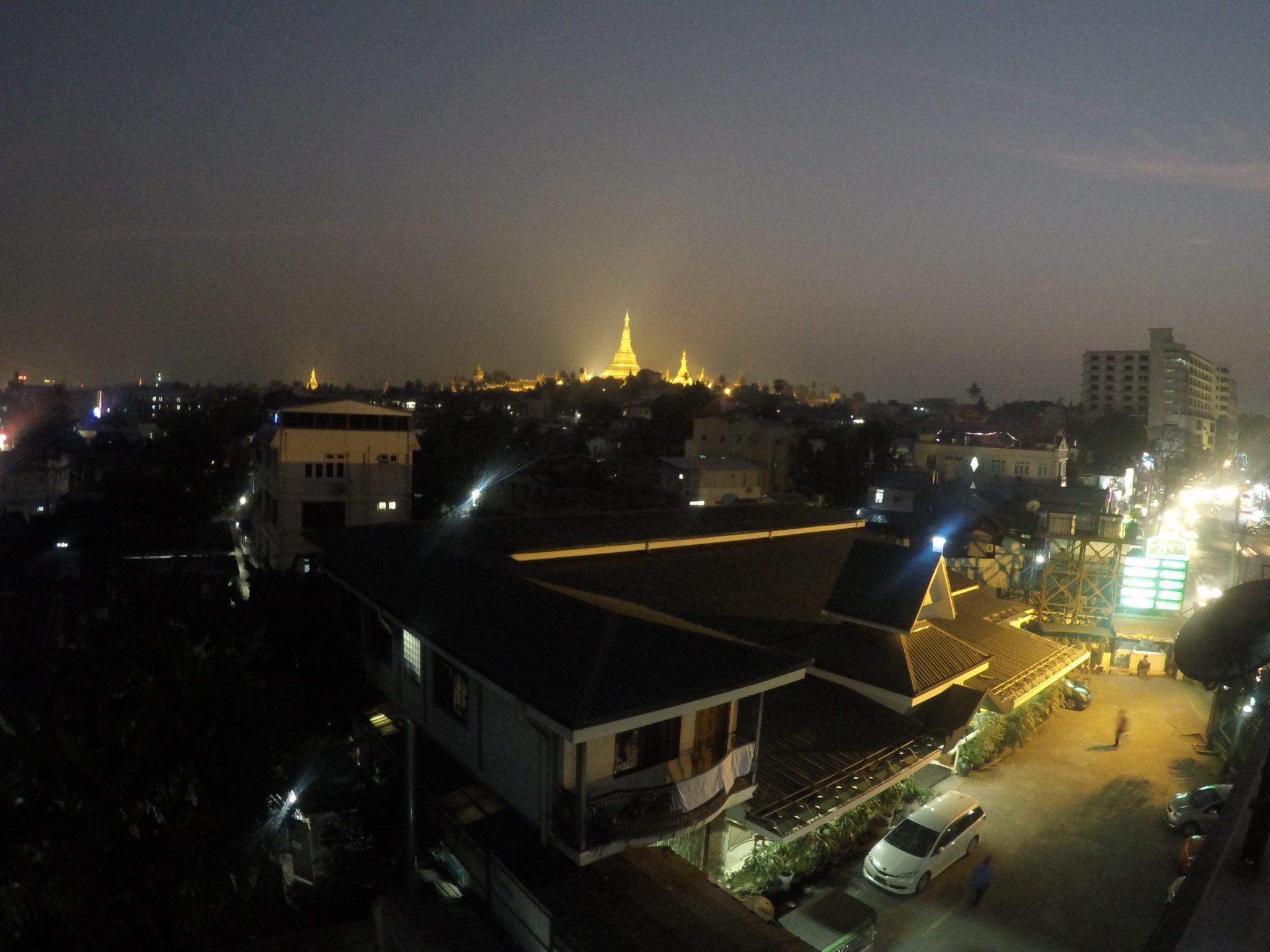
The Schwedagon Pagoda seen from afar. To see it inside, go have a look yourself, I won’t give it away
Mandalay really has nothing interesting going for it. It’s good if you want a quiet hotel (not hostel) and/or can find a cheap flight ticket here. Other than that it just functions as a bus/train/plane hub to nearby places of more interest. The only thing worth seeing in the city is a very picturesque teak bridge called U Bein Bridge. I personally recommend skipping Mandalay and focus on something more unique and special, namely ALL the rest of Myanmar.
Bagan – Temples galore
Note: I’ve heard from multiple sources (other travellers) that you can no longer climb the temples at night, ie. for sunrise and sunsets. This is a very large part of what makes Bagan unique. This is, however, still Myanmar and I’m sure you can just do it anyway – even if you do get “caught” then a small bribe or simply saying you’re sorry should be enough. Has anyone been there since this change that can confirm/update on this ? Please comment!
In short, this is a massive archaeological site boasting an astonishing 2700 (approximately) temples. During it’s prime it was closer to 13000. This doesn’t mean that the area is huge, in fact you can drive from one end to the other on an e-bike in about 30-60 minutes. Without having the exact numbers I’d estimate it to be an area of around 20 * 10 km.
The area is surrounded by 3 cities: New Bagan, Old Bagan and Nyang-U. The night-busses arrive in Nyang-U but most of the backpackers go to New Bagan – a taxi ride of about 7000 kyats although they will ask for 15000 from you. in Nyang-U there are cheaper (and worse quality accomodation) and in Old Bagan is where the more upscale accomodation is. I staid in New Bagan which is quite touristy and expensive but has a good vibe. Lots of backpackers in that area.
When you get there, rent an e-bike (motorbikes are not rented to foreigners in Bagan) and scoot around the temples. This is basically the whole thing. Go with a group of friends and see the temples or drive around alone and get lost in the land of temples. Find yourself an empty roof and just sit there and contemplate about things in life.
Finding a nice temple to be alone can be a very relaxing experience
There are very few bars in New Bagan and the temple area is the whole thing. But it’s worth it. This area is obscenely picturesque and when you see the sunrise/sunset you will fall in love. At sun-rise about 25 hot air balloons fly every morning, making for some of the most beautiful sunrises you will ever see.
The beauty of Bagan. Atleast some of it – so many amazing pictures have been taken in this area
Inle Lake
Most of the flashpackers you see out there will do one or two days at Inle Lake. It’s a small city called Nyaungshwe near the lake where everyone stays and it’s from here the tours/trekking starts.
The lake is beautiful and there is a reason why everyone goes here but it has become murky and brown even though just a generation ago you could drink from the lake. Motorized boats sailing around tourists add to this but mostly it is due to fishermen and other locals using the same motorized boats and fertilizers used in the floating gardens.
You can get a day-tour boat trip from any hostel you stay in taking you to the sights of the lake – the floating gardens, the four tribes living on the lake and the fishermen amongst other things. It makes for a great day and is worth doing. Remember sun-screen!
Fishermen on Inle Lake
Another day can be spent on a bicycle ride around the monastery’s and caves in the area. For an evening activity visit one of the two vineyards in the area – one is close and has an amazing sunset view but unfortunately lacks good wine – the other has good wine but is further away and requires a tuk-tuk ride or an avid bicycler.
If you spend more days in the area, you can go on two or three day hiking tours in the mountains or alternatively hike from Kalaw to Inle Lake instead of taking the bus directly to Inle. Trekking is always a fun activity and the mountains are beautiful – if you are going in the dry season some of the waterfalls along the Kalaw – Inle Lake route will be dried out so maybe a tour along the lake starting and ending in Nyaungshwe is better.
I recently took the incredibly scenic route from Khe Sahn To Phong Nha along the west leg of the Ho Chi Minh Trail in Vietnam. It was done on an old $280 Yamaha Nuovo Automatic 113 CC motorbike. The 240km’s took about 7 hours in a relatively fast pace but I recommend that you do it in 9-10 (get up early to avoid driving in the dark) as you are going to want to stop and suck in the scenery or maybe just take a long lunchbreak – although doing it in 6 is doable should you want to rush it. We left at 10:15 and made it an hour before nightfall
Vietnam Coracle describes the route as: “240km of winding road through incredible mountains, forests, and river valleys. There are no hotels, hardly any shops, and just one gas station on this entire stretch. There are very few settlements, vehicles or people. One local in Khe Sanh, bewildered at why anyone would want to go on such a road, described it as vắng người, meaning there’s ‘nobody there’.”
I rolled into Khe sanh around 4pm on a wednesday after leaving Hue the same morning. I’d been riding solo all morning and short of a dutch guy riding the other way I had not seen any foreigners. As usual it was a stunning route with kids waving and narrow bends.
I wanted to spend the night in Khe Sanh before heading into the 240km remote leg to phong nha. But where? I was looking for a group of people to join so as to not take the leg alone – what if I ran out of gas or had a flat in the middle of nowhere? so I checked the garage in all 4 hotels I could find in town to see if there were some long distance looking bikes anywhere but found none.
Even though I was slowly coming to terms with the idea that I would have to do it alone and that maybe this was allright – atleast I’d be able to stop when I wanted – I gave it one last shot and decided to grab a beer at the main road, helmet on, ready to go, just hoping someone would roll by. As luck would have have it, someone did roll by and chasing after them I ended up at my hotel for the night.
Heather was standing outside the hotel about to head out and I asked her about where she was going and what she was doing – to which she replied “beer by the river – want to come?”. I quickly checked in at the hotel and joined her. A group of 4 other Americans and a Vietnamese were sitting there with a hot pot and a crate of beer enjoying the Vietnamese riverside. Michael and Laura were on a 10-year anniversary trip, Bryan and Heather were both on long term solo travels and finally Jeff and Hao were just enjoying life together travelling around Vietnam for the time being. I had my crew.
The crew enjoying a pizza in Phong Nha after a long day
The ride: Khe Sanh to Phong Nha
Due to some motorbike problems with Mike’s bike we didn’t head out until 10:15 that thursday morning. We stocked up on about 2 liters of gas each and food for the day, some banh mi and fruit. Since we didn’t count on passing any gas stations and our bikes were all thirsty automatics we needed alot of gas. If you are doing this on a semi or the infamous Honda Wins, then you can probably make the whole 240km without extra fuel – especially since you can get a little bit of expensive gas along the way in a small city called Rinh Rinh.
The ride was, well, spectacular. As soon as you get to the trail there is pretty much just one way to go and all you have to do is just follow the road and let the scenery wash over you. Through valleys, mountains and settlements along rivers and waterfalls. You’ll be riding down low looking up at majestic mountain sides and you’ll be riding up high above the clouds which mostly can be described as driving in heaven.
We rode all day through areas where you didn’t see a person for 30 minutes
Remember to take the time to stop and smell the roses or in this case – the jungle
Through tiny settlements
A settlement along the way
We even briefly drove on some of the main roads of the area.
Just imagine how it looks in real life,when it looks this good on a cellphone picture
Reaching our destination
With no extra fuel and two bikes running on fumes well below the red area on the fuel gauge we rolled into Pepperhouse Homestay and within 5 minutes we were all in the pool with a cold beer. If you have a chance, go to Pepperhouse and say hi to the hosts, Multi and Diên, from me.
Pepperhouse Homestay
This concluded a long day of motorbiking but, man, was it worth it.