|

Naypyitaw – The official capital of Myanmar

This is post 6 of 12 in the series “South East Asia”

  1. Applying for a Myanmar (Burma) visa in Bangkok
  2. One night in Bangkok
  3. Visiting Rural Thailand – enjoy the silence
  4. Sleeping in a monastery on a mountain top in Hpa-An, Myanmar
  5. Overview of tourist hotspots in Myanmar (Burma)
  6. Naypyitaw – The official capital of Myanmar
  7. Being sick on the road
  8. The End of an Era – I’ve Sold My Motorbike and Left Vietnam
  9. Cambodia – First Impressions
  10. Koh Ta Kiev – Where the boat leaves from
  11. The Future of Sihanoukville, Cambodia and the Surrounding Areas
  12. What Were We Thinking (and other ramblings)

Update from Tyra (26-03-2017): It was possible to rent a motorbike for 30.000 Kyats for a day at The golden Lake Hotel. When I was first here it was impossible for foreigners to rent a motorbike. The police didn’t mind foreigners driving around on the motorbike either.

Introduction and History

Naypyitaw is the official capital of Myanmar – I say official because up until 2006, Yangon (Rangoon) was the capital of Myanmar and de facto still is. In 2006 the capital was moved to a grassfield 1km west of Pyinmana. There are many speculations about why this happened but the official reason is that Yangon had become too crowded and lacked potential for growth. Another reason is that Yangon was too close to the water and was too hard to defend in case of a naval attack – a rather medieval reason if you ask me. Less official reasons speculate that it’s political (surprise).

In either case it is now a massive strictly coordinated area with designated places for everything. Hotel zones, residental zones, military zones, commercial zones and even an embassy zone. The embassy zone only has one embassy in it – the Bangladeshi. All of these zones are mostly empty and this makes for a spectacular ghost town. The hotels are huge and modern and the roads are intense.

Parliament road, for example, is a 10 laned road – in both directions – and with only a couple of cars on it, this 20-lane road is an astonishing display of how to waste money. I mean – alright, you can use it for parading around your military but that’s about it. It’s something I could see North Korea think of as a good idea.

myanmar-20-lane-road
Sitting in the middle of this mostly empty 20-lane road

What to do in Naypyitaw?

As this city is the capital they actually keep all the laws of the country and this means that foreigners can neither rent a motorbike or a car and when the roads and the city in general span over a large area with no public transportation there is only one option and that is taxi’ing it around. We were two and we paid about 55000 Kyats total for a full day (almost 12 hours) where he took us whereever we wanted. He was not a tour guide as such so we relied on the internet as a source for places to go.

Below follows a short list of what we did:

Parliament road

The behemoth of a road is a sight to behold. We asked the driver to stop so we could take some pictures and instead of pulling over to the side he just stopped in the middle of the road. Well alright then. Let’s take some pictures. The police was standing right there too and didn’t care at all that we were tossing around the road.

The highway

There is a highway going from Mandalay to Yangon going through Naypyitaw which is also scarcely used but we went there anyway and drove a couple of kilometres out and back. It’s just a highway and as such you can skip this step. Only difference is that no rules apply and we did see our driver make questionable manoeuvres like u-turns, crossings and opposite direction driving.

Lunch

We asked the driver for a place and he took us to a nearby mall. As we where coming directly from overpriced Bagan, everything seemed very cheap – priced as it should be considering the general poverty of the country. We had some good noodles and got a haircut while looking around the mall. The mall had originally produced western commodities like Nike shoes and iPhones but still we didn’t see any other white people – obviously this place mainly sees local businessmen from Yangon and in general the richer part of the country comes here.

Uppatasanti Pagoda

This pagoda is an exact copy of the Shwedagon Pagoda in Yangon except that it’s 30cm shorter so as to not outshine the original. At first this might seem like a waste of time then as you’ve most likely already seen the one in Yangon, however, this experience is significantly different. First of all, while the Pagoda in Yangon is completely swamped with people, this one is practically empty – we were the only westerners there at all. Secondly, you get to go inside! Inside it is beautiful and this alone is well worth the trip. When we were there, there were some sort of ceremony going on with around 50 locals praying – something you wouldn’t see in Yangon.

Also worth mentioning are the walls covering the inside of the Pagoda as they are covered with paintings, revealing Buddhas path to enlightenment.

The Pagoda seen from outside. Practically noone here

Golf driving range

There are atleast 3 golf driving ranges which are publicly accessible and not very expensive. We spent an hour there, just shooting some golf balls. Good fun if you are into that kind of thing

The teak

The Teak, Restaurant and Spa is a high class Spa, Fitness and Restaurant. I was extremely impressed with the level of service that we got here – everything from the poolside restaurant to the full body massage. This place will make you very relaxed and spending the whole day here is not a problem.

Now, it is a little outside the normal backpackers everyday budget but if you feel like splurging for a day, this is absolutely worth the money! To put it in perspective, me and my travel companion at the time were both backpackers on a tight budget and this did not shatter our budget.

massage-naypyitaw
Inside one of the rooms where we got some very decent massage, to say the least

Water Fountain Park

Finally, the last thing we did before ending our day of sightseeing in Naypyitaw was to visit the Water Fountain Park. This cozy park is apparently where all the citizens go at night and is great for an evening stroll. The park has a quaint artificial waterfall that you can walk under as well as behind. There are lots of lights that turn on at night (ask the driver when exactly) and the whole park is definitely worth a visit.

We had a our driver walk around with us – and as the evening drew to an end we talked a bit with him and generally this was a great way to end a great day.

water-fountain-park-naypyitaw
The waterfall inside the Water Fountain Park

Conclusion

This place is geared towards domestic businessmen. There are upscale restaurants and business class hotels. You can’t rent anything as a foreigner and will have to rely on taxi’s to get around. Despite this, the place is great if you just want to have some surprisingly cheap luxury (cheaper than Bagan and Inle!) including big air-conditioned rooms and spas/massages.

Add to that, the train rides to and from Naypyitaw are taken by only locals and on top being ridiculously cheap (1,5eur for 10hour trip) there are only locals there and the train trips serve as noteworthy experiences all by themselves. We took train rides from Bagan to Naypyitaw and then from Naypyitaw to Bago.

train-myanmar
Just casually hanging out the door of a moving train. Taking a trip with these 100 year old trains is like stepping into a timemachine

It is also great if you just want to experience a truly unique place and I guarantee you, dear reader, that this place will leave you in awe.

Similar Posts

  • |

    Long-term living on Bali – Hindu full moon ceremony

    This is post 3 of 3 in the series “Long Term stay in Ubud, Bali”

    1. Long-term living in Ubud, Bali – The foreigners
    2. Long-term living in Ubud, Bali – The local life
    3. Long-term living on Bali – Hindu full moon ceremony

    Continued from part 2…

    This is a series about various observations and reflections I’ve had while staying in Ubud, Bali for a month.

    How we got to go to the full moon ceremony aka Bulan Purnama

    We (Amy and I) noticed that the hostess and the rest of the staff regularly went to the nearby Pura Puseh temple in Ubud and since the staff has been so overly friendly and forthcoming towards us with everything else we thought we’d ask them if they could take us. We thought about going to the temple ourselves to see but I’m glad we didn’t because it would have been like sending two elephants into a porcelain house – we’d stick out like two sore disrespectful thumbs.

    “At this point we didn’t know what kind of experience to expect and honestly I just thought it would be a standard Sunday ceremony.”

    They suggested we go a few Sundays later (yes, you guessed it – they said yes) and without thinking further about it we smiled, said thanks and started to look forward. At this point we didn’t know what kind of experience to expect and honestly I just thought it would be a standard Sunday ceremony. We would later find out that this was actually a bi-annual event called Bulan Purnama, a full moon ceremony that lasted for four days!

    Full moon ceremony, bulan purnama balinese clothes
    The staff that was friendly enough to take us to full moon ceremony. It’s Amy on the left.

    Full moon ceremony preparations

    After visiting countless temples around South East Asia you’ve become used to certain requirements to clothes (long pants, cover your shoulders etc.) but for this ceremony the requirements to clothes were even more strict. Two bags of clothes were kindly handed over to us from the staff prior to the ceremony. One bag for me and one bag for Amy.

    Amy’s bag contained:

    • Sarong – A sort of skirt to wear as the lower part of the dress
    • Corset – In earlier days the women went topless.
    • White shirt – In our group we all wore the same style shirt and I think it represents caste/family/relationship.
    • Selandang – A colourful piece of cloth tied around the white shirt as a belt.
    classic balinese clothes full moon ceremony
    Traditional Balinese attire. The sarong, the selandang, the corset and the white shirt.

    My bag contained:

    • Large colourful sarong – Used as inner sarong and only the front part could be seen
    • Small white sarong – Used as outer sarong to create a two-layer effect
    • White shirt
    • Selandang – same as for the women
    • Udeng – A special type of white hat worn by all men.
    wearing traditional balinese attire full moon ceremony bali
    Wearing the traditional Balinese attire


    With these clothes, we felt significantly more prepared. It was also at this point we realized the grandeur of the ceremony. They didn’t do this every weekend. Since the women had all set up their hair and the men were wearing hats literally no one was wearing helmets. It seemed the whole region was heading for the temple.

    “With these clothes, we felt significantly more prepared. It was also at this point we realized the grandeur of the ceremony.”

    Arriving at Pura Puseh (the temple)

    As we approached the temple of Pura Puseh in the middle of Ubud we saw hundreds of locals dressed in local attire and a nearby field had been turned into a parking lot to accomodate all the motorbikes rolling up.

    If you’ve been in a similar situation you’ll know that it can be very overwhelming to be so suddenly and deeply submerged into foreign culture. You don’t know where to go and what to do – and more importantly: you don’t know what not to do.

    full moon ceremony in bali ubud
    The full moon ceremony (Bulan Purnama) is in full effect!

    To give an example, you are supposed to go by a small fountain next to the entrance and sprinkle yourself with holy water before you enter the temple. It’s easy to miss a detail like that so you’ve got to pay close attention to avoid showing disrespect.

    “Anyone who’s been in similar situations knows that it can be very overwhelming to be so suddenly and deeply submerged into foreign culture“

    The Full moon ceremony commences

    The ceremony starts in the morning but doesn’t end till around 10pm because of the many waves of people having to go through the full ceremony. It takes about 1 hour for a ceremony but two parallel ceremonies happen simultaneously – one in the outer temple and one in the inner.

    Add to this, the fact that the full moon ceremony (Bulan Purnama) runs for four days straight! That’s a lot of people!

    We performed two rituals – first in the outer temple and second in the inner temple. Before each ritual a flower bowl with incense sticks was prepared for every person.

    “Add to this, the fact that the full moon ceremony (Bulan Purnama) runs for four days straight! That’s a lot of people!”

    Outer temple ritual

    The outer temple ritual consisted of 5 steps as follows:

    • Step1: Hold your hands over the incense to “catch” the incense smoke and afterwards pray with your (empty) hands in front of your face. I didn’t get the full details but I’m assuming the “catching” of smoke is a way of cleansing.
    • Step2: Repeat the same procedure but this time you’re holding a yellow flower while you pray. The yellow flower is then put behind your ear.
    • Step3: Repeat the same procedure but this time with a small bucket of flowers
    • Step4: Repeat the same procedure but this time with two flowers, a red and a yellow. Once again, you put them behind your ears afterwards.
    • Step5: This is the same as step1.
    full moon ceremony bali praying flowers
    This is step3 of the ceremony where I’m praying with my hands in front of my face while holding a small bucket of flowers

    My guess is that step 1 and 5 is cleansing before and after the ritual while step 2, 3, and 4 each represents praying to one of the three primary gods in Hinduism:

    • Brahma, who creates the universe
    • Vishnu, who preserves the universe
    • Shiva, who destroys the universe

    To make sure everyone follows the same pace, a man with a small bell sets the pace. Each step is performed as long as the bell is ringing.

    “Step 1 and 5 is cleansing before and after the ritual while step 2, 3, and 4 each represents praying to one of the three primary gods in Hinduism:“

    After the ritual, everyone proceeded to the inner temple, bringing with them flowers and offerings.

    balinese full moon ceremony women carrying offerings
    Offerings are carried around the crowded temple by the women. Mostly they are carried on their head and often without the use of hands

    Inner Temple Ritual

    Inside was a completely new set-up of Gamelan musicians. To give you an idea of the sheer size of this ceremony, the outer ceremony had about 20 Gamelan musicians while the inner ceremony had closer to 50 musicians.

    gamelan musicians inner temple full moon ceremony pular punarna
    A subset of the Gamelan musicians performing in the inner temple. The lady smiling at us is our hostess, Wayan.

    The first part of the second ritual is the same as the entire first ritual. However, after this is done there is an addendum.

    “To give you an idea of the sheer size of this ceremony, the outer ceremony had about 20 Gamelan musicians while the inner ceremony had closer to 50.”

    All the offerings are carried to the offer site and while the offering ritual is being performed ladies walk around with holy water (it had a very smoky smell and taste to it) and a second ritual is performed by each person individually:

    Step 1-3 is done 3 times

    • Step1: They give you holy water in your hands and you wash your face. This is done 3 times.
    • Step2: They give you holy water in your hands and you drink. This is done 3 times.
    • Step3: They give you holy water in your hands and you put it over your head. This is done 3 times.
    • Step4: Rice is put on your neck and your forehead. It sticks to your body as you are wet from the washing.

    Finally, after this step, the ceremony is over and everyone proceeds to the exit. Next group comes in and the ritual is repeated for the next group


    kids at bali full moon ceremony ubud
    Two adorable kids at the full moon ceremony.

    After the full moon ceremony

    Although most people have the whole weekend and monday off there are still things to do and a large chunk of the ceremony goers head straight home. The majority though, sticks around and participates in the general festivities across the road from the temple where everyone is dancing and singing.

    Around 12pm everything ends, the streets can finally rest and only the silence sticks around; until the next the day when the cycle repeats.

  • |

    What Were We Thinking (and other ramblings)

    This is post 12 of 12 in the series “South East Asia”

    1. Applying for a Myanmar (Burma) visa in Bangkok
    2. One night in Bangkok
    3. Visiting Rural Thailand – enjoy the silence
    4. Sleeping in a monastery on a mountain top in Hpa-An, Myanmar
    5. Overview of tourist hotspots in Myanmar (Burma)
    6. Naypyitaw – The official capital of Myanmar
    7. Being sick on the road
    8. The End of an Era – I’ve Sold My Motorbike and Left Vietnam
    9. Cambodia – First Impressions
    10. Koh Ta Kiev – Where the boat leaves from
    11. The Future of Sihanoukville, Cambodia and the Surrounding Areas
    12. What Were We Thinking (and other ramblings)
    Lavender, France
    From our trip to the lavender fields of France

    A few months ago (who can remember exactly when), we decided to go on another trip.
    I, Thor, wanted to see the rest of the world (south america and Antarctis). Both Amy and I wanted to visit friends and family.
    At some point Amy has to have some continuity and get a career in Denmark and at some point we will make a family and then it’s hard to travel long-term.

    Not now, though. Not now. Now it’s easy. Amy and I both quit our jobs and on a rainy day in August 2018 we took a plane to Vietnam. (And that answers the title question:))

    We just came back from 10 days on Iceland – and what a blast!

    Looking forward, at this point in time, we knew that we would be heading to Vietnam to plan our wedding July, 2019 and to visit Amy’s family. I’d be meeting her parents for the first time. Gasp!

    We also knew we’d be going to Indonesia for a work opportunity.

    Japan was on the itinerary to visit my, now, good friend JJ who was doing a sheep show there and my Niece, Tyra, who was doing half a year of study abroad on her asian studies degree

    Finally, since this was also our honeymoon, we had (one-way) tickets to Hawaii, USA.

    After this we’d be going to central America, Guatemala, South America, Antarctics. Possibly – plans change.

    All this and home for christmas… or in january…

    Keep looking back at this page. We’ll try to keep it updated. As well as on social media

    Instagram

    Facebook

    Thor and Amy!

  • |

    Sleeping in a monastery on a mountain top in Hpa-An, Myanmar

    This is post 4 of 12 in the series “South East Asia”

    1. Applying for a Myanmar (Burma) visa in Bangkok
    2. One night in Bangkok
    3. Visiting Rural Thailand – enjoy the silence
    4. Sleeping in a monastery on a mountain top in Hpa-An, Myanmar
    5. Overview of tourist hotspots in Myanmar (Burma)
    6. Naypyitaw – The official capital of Myanmar
    7. Being sick on the road
    8. The End of an Era – I’ve Sold My Motorbike and Left Vietnam
    9. Cambodia – First Impressions
    10. Koh Ta Kiev – Where the boat leaves from
    11. The Future of Sihanoukville, Cambodia and the Surrounding Areas
    12. What Were We Thinking (and other ramblings)

    Update 18-10-2017: As per comment on this post, it looks like it’s no longer possible!

    Update 20-10-2017: I asked my niece who was there 7 months ago and she went up there and slept just two days before it happened. She also says that she’s heard alot of people say they couldn’t go up there anymore.

    Please confirm / de-confirm if you have updated knowledge

    Note: for detailed practical information, scroll down

    The mission (and its complications)

    The first time I saw the monastery in Hpa-An was while visiting a field filled with statues of Buddha, more than 1100 actually. There, in the distance on a mountain top, I saw the monastery and I immediately wanted to go up there. I knew it was possible to go up there and climb down the same day but I’d also heard people talk about sleeping in the monastery. However, there were some implications.

    buddha field with a view to mt zwegabin monastery
    Standing between a sea of buddhas with a view to the monastery. Do you see it? It’s right there!

    First of all, I wasn’t sure if it was even legal/possible with the Myanmar government having some strict laws against foreigners (hostels have to have a license to be allowed to host foreigners) and I was getting mixed signals from asking around – some said it was possible, some said it wasn’t. Secondly I had to actually climb 2000 steps and finally I was probably going to have to sleep on a rather hard surface with nightly temperatures actually making the experience a rather chilly one. Even though it was warm in the day, it got chilly at night.

    After getting direct confirmation from people who had done it I was convinced and my mission was clear:

    1. Climb the 2000 steps
    2. Watch the sunset
    3. Sleep there
    4. Watch the sunrise
    5. Climb down

    The ascend to the monastery

    I started the ascend from the bottom of the mountain around 15:30 (3:30pm) carrying with me 1 litre of water, a hoodie, a camera, a phone, my wallet and a power bank. Around 17:00 I finished. I believe it can be done in 1hour with someone experienced but takes more like 2 hours if you are not rushing, I did it in 1:25. The first step of the way I was following a guy that was going pretty fast but halfway up (after only 35 minutes) he got ahead of me and I slowed down my pace considerably after that.

    beautiful-hike
    Halfway up the mountain, the view is already beautiful. It was an astonishing hike

    The steps seemed to be endless and just when I thought I’d made it another leg of stairs revealed itself. In the end I found that a very slow speed (like a step every second) was the way to go, as I almost didn’t have to take any breaks like that. Slow and steady wins the race and finally I got there.

    The top

    At the top there was a sleeping hall for the monks, a sleeping hall for tourists and a restaurant like building where they cooked food. It was also possible to buy food there as a tourist between 6pm and 7pm. There was of course also a few Pagodas and other religious symbols. And then there were monkeys – aggressive monkeys. They would snatch anything you had left unnoticed including things out of purses and coke cans out of your hands. Luckily there were also dogs and all through the evening the dogs and monkeys would fight each other – the monkeys would come close and the dogs would bark them away. It was fun to watch how, as soon as someone made a little scream due to a monkey coming too close, the dogs would come running instantly to scare them away.

    Quickly after reaching the top, I sat down at the eating area and was offered free food and tea by the monks – not enough for dinner, but enough to keep me going until real dinner later that evening.

    The rest of the evening was spent watching the monkeys and the sunset and also the 8 of us up there who were tourists played a bit of cards before hitting the bed early.

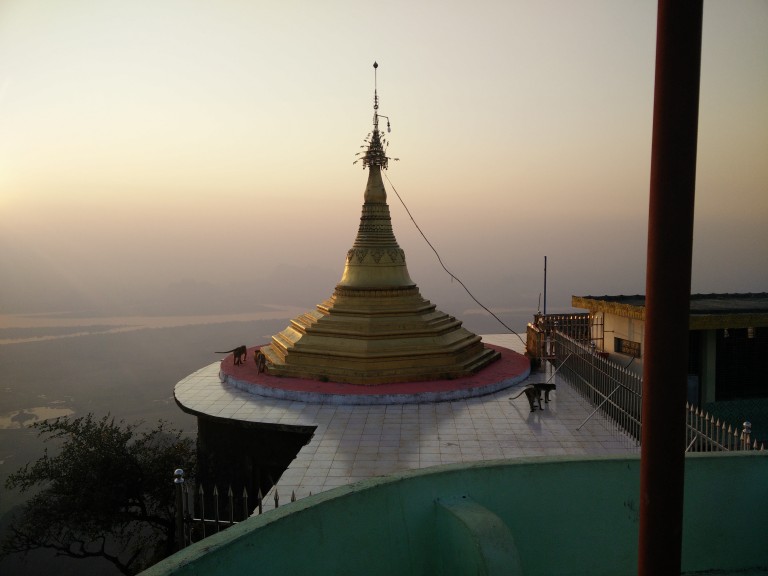
    sunset at top of mt zwegabin in myanmar
    View from the top of the monastery as the sun sets over Myanmar
    evil monkeys
    Evil mischievous monkeys

    The descend

    The descent in the morning around 6:30 was much quicker. I got down and scooted back to town to return the scooter. I had made an agreement with the scooter renters to not charge me an extra day even though they technically want you to return it the evening before. One thing to note though is that you should stretch! I could feel my calves for days after that descend.

    Practical information

    • It takes about 2hours to climb the steps, 1hour if you are fast, 3 hours if you are slow
    • Sunset is around 5:45pm but depends on time of year. I started at 3:30pm  and made it easily.
    • The first four to check in will be sleeping in twin rooms (2 in each – seperate beds)
    • The rest will sleep in a sleeping hall
    • Beds are not soft but not rock hard either
    • You are expected to give around 5000 kyats in “donation” to sleep there
    • There is food up there and you will be provided with a blanket. You can also buy soft drinks – no beer!
    • I slept in shorts and a hoodie and that was warm enough – I was in a twin room. This was in winter time
    • There was power in the twin room
    • The climb is fairly rough and steep but I’m not trained at all and I would say anyone could make it, given enough time.
    • You’ll be in shade about half the time
    • I rented a scooter to get there and left it overnight. Another guy hitchhiked there and back – it’s not hard.
    • There are two entrances and the main is at the field of Buddhas about 30 mins out of Hpa-an- ask around but it’s not hard to find.
    pagoda-mt-zwegabin-monastery
    One of the Pagoda’s at the monastery on top of Mt Zwegabin
  • | |

    One night in Bangkok

    This is post 2 of 12 in the series “South East Asia”

    1. Applying for a Myanmar (Burma) visa in Bangkok
    2. One night in Bangkok
    3. Visiting Rural Thailand – enjoy the silence
    4. Sleeping in a monastery on a mountain top in Hpa-An, Myanmar
    5. Overview of tourist hotspots in Myanmar (Burma)
    6. Naypyitaw – The official capital of Myanmar
    7. Being sick on the road
    8. The End of an Era – I’ve Sold My Motorbike and Left Vietnam
    9. Cambodia – First Impressions
    10. Koh Ta Kiev – Where the boat leaves from
    11. The Future of Sihanoukville, Cambodia and the Surrounding Areas
    12. What Were We Thinking (and other ramblings)

    Waking up late

    Bangkok is a rough time if you don’t like noise, people, beer, lights and general chaos… However, if you do it’s an experience worth having.

    Bangkok Temple crawl

    Me and two mates (Chip from the US and Soloman from Scotland) decided to go for a bugs and temples day which would start out with temples in the morning and then later bugs in the evening. I’d looked up a couple of temples that I thought interesting and dotted them into Google Maps so with those we had a general plan.

    Soloman had to switch hostel and since most of the temples were in that vicinity, we jumped in a cab got him checked in at the new place and started walking towards the temples.

    We saw the Royal Grand Palace and it is incredibly large. We got 4 tickets at the entrance and only ended up using one. After walking around in the sun for a couple of hours without food or water we got to a point where we’d seen enough Grand Palace. It’s amazing but also huge so after seeing the emerald Buddha we left to get some water.

    Royal grand palace in bangkok
    One part of the Royal Grand Palace. The palace is huge!

    Next stop was Wat Pho which is where the Reclining Buddha is at. It’s a massive gold Buddha located inside the temple. It’s called the Reclining because of the very relaxed position the Buddha is assuming. Definitely worth a visit.

    reclining buddha in wat pho
    The reclining Buddha in the Wat Pho temple in Bangkok. It is not possible to see in this picture but the buddha is about 50 meters long

    Final stop was Wat Arun. Unfortunately, it was closed for renovation but we did get to cross a river using a local boat. It was an interesting experience since the river is completely filled with boats – large, small and even a tugboat with a barge was coming through. A bit chaotic but we managed to get across. And as it was only 2.5Baht (7 us cents) there is not really any room for complaining. The area around it was very interesting and we did manage to get lost, suddenly ending up in a school area surrounded by thai kids in uniforms and some very small local streets. So even though the temple was closed, the trip across the river most certainly was not for naught.

    Back at the hostel

    After visiting Wat Arun we were all tired and needed food and rest after a full day of walking in the sun, so after watching a free Muay Thai fighting match for about 15 mins (the match ended with a brutal KO), we got back to my hostel.

    Every day there would be someone sitting out on the terrace in front of the hostel having a beer and today was no different so we quickly joined them. This lasted the next 4 hours from around 8pm to 12pm, the same as every day, as this is when the hostel stops serving alcohol. During this time, I managed to get some food and an hour of sleep too so that I was a bit more rested. I still hadn’t gotten to eat bugs yet and I was determined not go to bed before tasting bugs.

    Finally getting to eat bugs

    Around midnight we all grabbed a cab to a place called Nana Plaza in the city center. It’s the second most party street of Bangkok but not really that appealing. It’s characterized by a lot of old white people walking the streets, overpriced beer and working girls everywhere. It’s a place you can visit once and then the charm goes off pretty quickly. Debauchery and gluttonous indulgence at its finest so we only stayed for one beer. As I was anxious to get a bite of some zesty bug I convinced the others to make the next stop a street food vendor around the corner that we saw on the way in.

    bugs in bangkok
    Eating bugs in Bangkok

    The bugs as you see them above are not as bad as they look. The easiest bugs to eat are the little white maggots as the taste resembles salted chips. The crickets (both large and small) have the same taste but the legs are annoying as they are hard to eat and get stuck in your teeth. I later learned that the trick is to hold the legs and eat the rest – just like you would not eat the tail of a shrimp. The beetles were the hardest as the hard shell makes for a very inconvenient bite to eat – not a single one of us managed to eat one without spitting it out. However, we later learned that the way to eat them is to peel the shell off and only eat the inner part of the bug. This makes sense and would certainly be easier but it’s hard work for very little food.

    All in all bugs were a very interesting experience and I was pleasantly surprised with the taste although I would probably steer clear of them if I had the chance to eat a good pad thai instead.

    Khao san road

    After the bug eating experience we went to Khao San Road which is the main party street of Bangkok. After a cab ride with a man that enjoyed breaking the law by going 120km/t while blasting through red lights, we made it. The night was just a “normal” Bangkok style party after this where we ended up in a disco dancing the night away until around 4:30am. By the end of the evening my MiFit watch told me I had moved around 30000 steps or the equivalent of about 13miles – the target is 8000 steps. It was a rough day but included so much of what you can do in a city like Bangkok. Although I only had 3 beers total the entire night, it was quite a rough day/night and one I’ll remember. I also slept like a log that night.

    banana-stand in khao san road
    Doing a banana-stand at Khao San Road in the heart of Bangkok
  • |

    Welcome to Da Nang. Now what?

    What kind of city is Da Nang?

    Da Nang is a pearl of a city on the coast of Vietnam. Placed just south of Hai Van Pass, halfway up Vietnam, it’s a cultural melting pot of Western and Vietnamese.

    Just north of the gorgeous Hai Van pass you have the old emperor city of Hue and the large Bach Ma National Park. South, you have the white sandy beaches of Hoi An. West, you have the mountainous highlands. And East? Well, you have Cham islands and the Pacific ocean.

    Friends on a rock at the top of Ban Co Peak with Da Nang city behind
    Overview of Da Nang from the top of Ban Co Peak
    Read More “Welcome to Da Nang. Now what?”
  • |

    Cambodia – First Impressions

    This is post 9 of 12 in the series “South East Asia”

    1. Applying for a Myanmar (Burma) visa in Bangkok
    2. One night in Bangkok
    3. Visiting Rural Thailand – enjoy the silence
    4. Sleeping in a monastery on a mountain top in Hpa-An, Myanmar
    5. Overview of tourist hotspots in Myanmar (Burma)
    6. Naypyitaw – The official capital of Myanmar
    7. Being sick on the road
    8. The End of an Era – I’ve Sold My Motorbike and Left Vietnam
    9. Cambodia – First Impressions
    10. Koh Ta Kiev – Where the boat leaves from
    11. The Future of Sihanoukville, Cambodia and the Surrounding Areas
    12. What Were We Thinking (and other ramblings)

    After crossing the border to Cambodia by bus the first town we encountered was Ban Lung. Although similar in many ways, once you look closer there are many differences between this town and the similar town of Pleiku in Vietnam on the other side.

    Ban Lung is a fairly remote “genuine” Cambodian town about 1 hour from a small remote border. Of course, cities like Siem Reap and Phnom Penh are significantly different but I think it’s fair to compare Ban Lung (Cambodia) with Pleiku (Vietnam).

    First of all, in Ban Lung, there are more cars and less motorbikes and the motorbikes are older. My pointed out that the motorbikes they drive here are like the motorbikes in Vietnam 10 years ago. And unlike Vietnam, almost no one wears helmets.

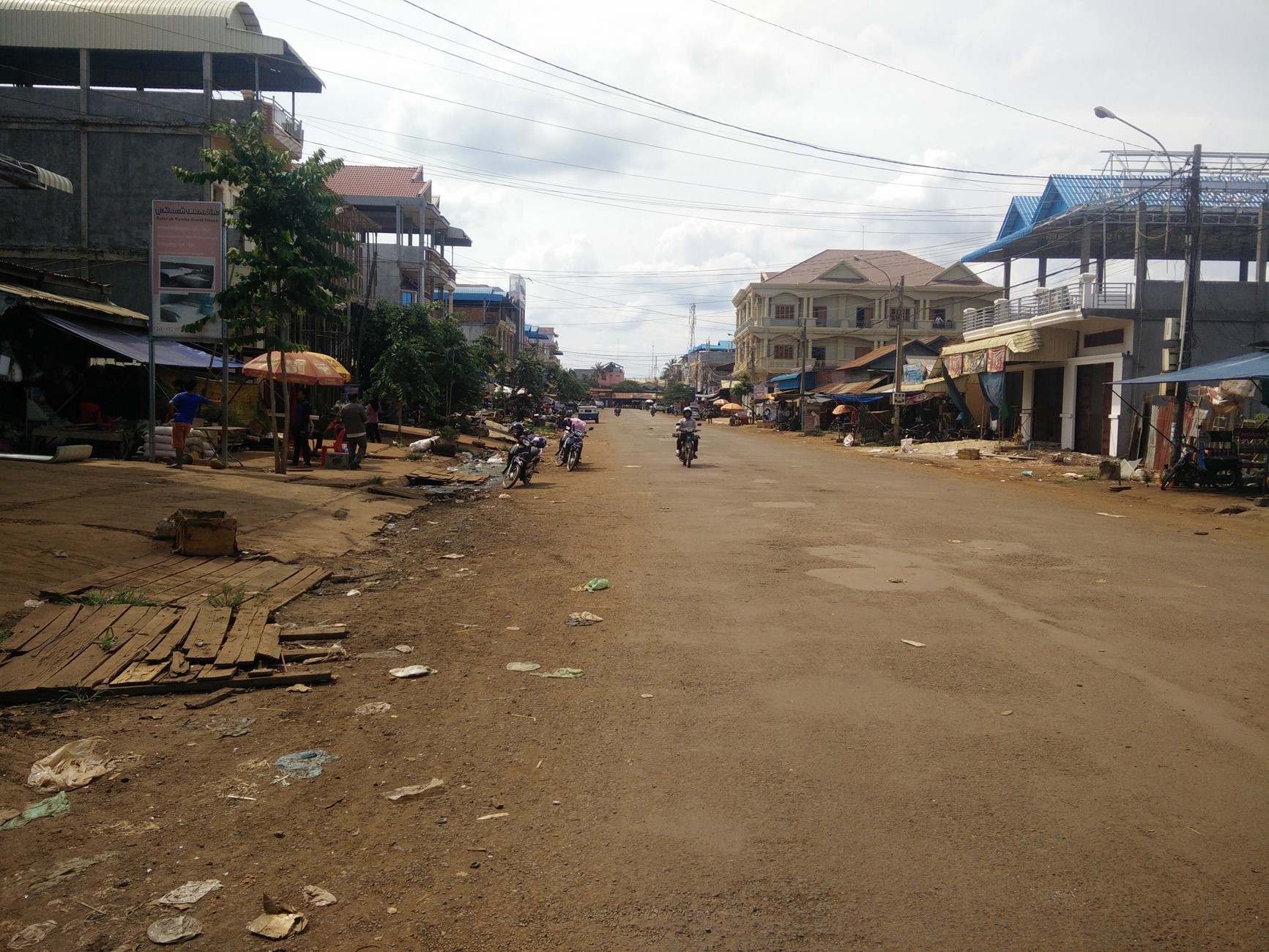
    The second thing you notice are the streets. They seem dustier, more “sad” – in lack of a better word. The houses are of poorer quality and more spread out.

    Dusty main road with low buildings in a Cambodian town

    Why are there so many pharmacies!?

    Now, when you take a closer look at the streets you’ll see that for this town particularly there is an abundance of pharmacies and moneychangers. My initial guess was that drugs are cheaper or more accessible here so many Vietnamese cross the border for this very reason – this would explain the moneychangers – this is a border town after all. Another theory is that since this used to be a French colony they adopted the French style pharmacies where they double as convenience stores selling shampoo and snacks and things like that. Contrary to Denmark, for example, where they only sell drugs and medicine. To me, it still doesn’t justify that literally every third shop was a pharmacy – and by far it hasn’t been as striking in other Cambodian cities as it was here. Please comment if you have a theory or better yet, know!

    That air-conditioner you’d gotten used to in Vietnam – not in Cambodia.

    All over Vietnam, even in the cheapest places you’d get air-condition. It usually wasn’t really an option to go for a fan-only room. In Cambodia, however, the default is fan-only. You can get air-condition in Cambodia but it’ll usually cost you $4-5 which is a lot when a room is $6. Alright, after a while you get used to the heat and air-condition isn’t really that important but the point here is that it’s a symptom of the general state of the room. Many cheaper places don’t have hot water, the rooms are smaller and simpler, and bugs crawling around is a thing you’ll have to accept. So in this sense, Cambodia is cheaper because there are cheaper options but if you compare two similar quality rooms – Vietnam comes out cheaper I’d say. There are of course exceptions to this as I just made a very broad generalization.

    Oh yeah, this goes for food as well. Cheaper but grimier solutions in Cambodia. Walking around town we had trouble finding a place that looked clean enough that we wanted to eat there.

    Otherwise, it’s pretty much the same isn’t it?

    There is one last thing worth mentioning which is significantly different. The money. Although Cambodia has a local currency, Riel (4000Riel = 1$USD), Cambodia runs on US dollars. Everything is given in dollars except for marketplaces and very local spots. It’s also used for small prices as 4000Riel to 1$ makes it a lot more granular. They even have a 100Riel note (0.025$).

    All over South East Asia you will see many prices given in dollars and especially if you go to places with tourists but this is different. Here, even the ATMs give dollars. You can find ATMs giving local currency but they are rare and only accept local cards. I have yet to find a place where they don’t accept cool dollars. So you wouldn’t really need the local currency at all if it wasn’t for the fact that dollars are likely to be rejected if they are not in close to mint condition while riel you can chew up and spit out again and they still work. For those often changed cash, riel is better.

    A funny anecdote is from the first time I tried to get cash from an ATM. I put my card in the machine and it asked me how much I wanted (without options as there usually are or the currency expected) so I clicked 800000 ($200) and pressed accept. It didn’t work. It now told me it had to be a number you could get with 35 notes. Great! Could you now please tell me what notes you offer, dear machine. I tried a little lower, 350000, guessing the machine had 10000 riel notes. At that point I gave up and thought it was just the ATM that didn’t work. Later, I found out that they run on dollars and by pressing 200 on the machine I got 2 100$ bills. Apparently it means that it runs on $100 bills – just like the machines in Las Vegas. Also worth noting is that although I didn’t test this out, in theory, with 35 notes you can get $3500 – quite a significant amount!

    So that’s about it. The rest you will have to experience for yourself! … or maybe stick around for my next post

Leave a Reply

Your email address will not be published. Required fields are marked *