Traffic. Traffic is terrible in Ho Chi Minh City, Vietnam.
It’s been about 14 months since I was here last and I swear it feels like traffic has gotten worse – or maybe I’ve just forgotten.
Amy has forgotten how to drive here. She rented a motorbike and drove out. 20 mintues later she was back – she wasn’t able to cross the roads in this chaotic city. Red lights are taken as suggestions. You must be constantly aware of your surroundings.
After less than 24hours we’re ready to leave this city.
Vietnam, the place where you can get a Pho for a dollar and a freshly made pineapple juice for 50 cents.
Da Nang. The pearl of Vietnam. Where the traffic police isn’t corrupt and where the streets are clean. Good food, good people, amazing beaches and weddings by the dozen. We’ve established ourselves, got upgraded to an appartment with two rooms and a kitchen. Life is good
I got on a motorbike for the first time in a year – shaky at first but I’m getting the hang of it again. Traffic is nowhere near as bad in HCMC but still – rush hour in the city center – not for everyone.
I’ve spent the first part of this post talking about traffic. It says something about the impact it leaves on you. But there are other things…
When you come here you’ll see everything from “hamburger bros” selling western style burgers to local places serving pipefish, ostrich, pork belly and other local delicacies. Where you can point at the fish while it’s still alive and you can make sure the food is fresh.
The place where you can get a Pho for a dollar and a freshly made pineapple juice for 50 cents.
An hour massage will set you back about $12.
Vietnam, where the toilet doubles as both the laundry room for the family, and where the dishes are washed for the guests. Where you learn some perspective about what hygiene is. In western culture we’re obssessed with cleanliness.
All of the above and many more things is why I love Vietnam. It’s like I feel at home here but it also feels like I’ve been away for a decade. It’s so vastly different from my home culture. When I’m driving on my motorbike with Amy on the back I’ve got a sensation of freedom and fear in equal parts. Of adventure and uncertainty.
Oh, how I’ve missed the joy of open-ended long term travelling. It’s good to be on the road again
Thor Winther is an engineer by profession but has been travelling the world full time since late 2015. He is the author of www.worldwidewinther.com, a blog focused on budget/backpacking solo round-the-world travelling.
“Nhan Mountainboasts interesting architecture, pleasing surroundings and is a historically significant spot for the Cham people. This trifecta of interest makes it a must visit for anyone who has the chance – foreign and domestic tourists alike.”
Nhan Mountain (Núi Nhạn) is found rising high near the city center of Tuy Hoa, the capital city of the Phu Yen province in Vietnam. Nhan Mountain boasts interesting architecture, pleasing surroundings and is a historically significant spot for the Cham people. This trifecta of interest makes it a must visit for anyone who has the chance – foreign and domestic tourists alike.
Aerial photo of Nhan Tower. Original Photo Source: Internet
For those very reasons, Nhan Mountain is the first thing locals think about when Tuy Hoa is mentioned. It’s become a famous landmark for Tuy Hoa and the entire Phu Yen province.
Even so, Nhan Mountain isn’t often visited by foreign tourists, simply because very few know about Tuy Hoa (or even Phu yen) at all. In other words: it’s a hidden gem.
Architecture and Religion of Nhan Mountain
So far, the Cham people technique of placing bricks tight together without any kind of mortar or adhesive has remained a secret to researchers.
Standing majestically on top of Nhan Mountain, Nhan Tower is an amazing piece of architecture. Nhan tower was built by the Cham people, who lived in the Đà Rằng delta region, between late 11th century and early in 12th century period. It’s the most unique symbol of the long-standing culture of the Cham people.
Nhan Tower up close. The two girls in the foreground are wearing traditional Vietnamese clothes (Ao Dai). Photo: My Nguyen
When the French colonists invaded Vietnam (1945-1954), they destroyed parts of Nhan tower causing a lot of damage. However, Phu Yen authorities fully repaired and restored both the inside and the outside of the tower in 1960.
The tower itself is a quadrant with four stories’. The tower is 25 meters high and each side of the tower is 10 meters high. The four-story tower illustrates the beauty, art and creativeness of the Cham people and resembles the architecture found in other places such as the Po Nagar Cham towers in Nha Trang.
The roof is made of a lotus bud stone slab which is a Linga symbol of the Cham people. In the top of the tower, four sides have false windows to distinguish between the upper and lower tower.
Inside the tower, the wall was built perpendicular from the bottom to the end of the body. The closer to the top, the smaller it is resulting in a pyramidal roof without the use of terracing or pilasters.
Another sculpture of Durga the goddess, may be found inside the temple: it depicts the four-armed goddess holding a hatchet, a lotus and a club while standing on a buffalo. This sculpture belongs to the Tra Kieu style of Cham art from the end of the 10th century to the beginning of the 11th century.
Durga, the slayer of the buffalo-demon, is represented in the temple. Original Photo Source: Internet
Nhan Tower is not only a historical and cultural relic but also represents typical architectural and sculptural work of the Cham people. The tower was built using bricks and decorated with stones and ceramics. So far, the Cham people technique of placing bricks tight together without any kind of mortar or adhesive has remained a secret to researchers.
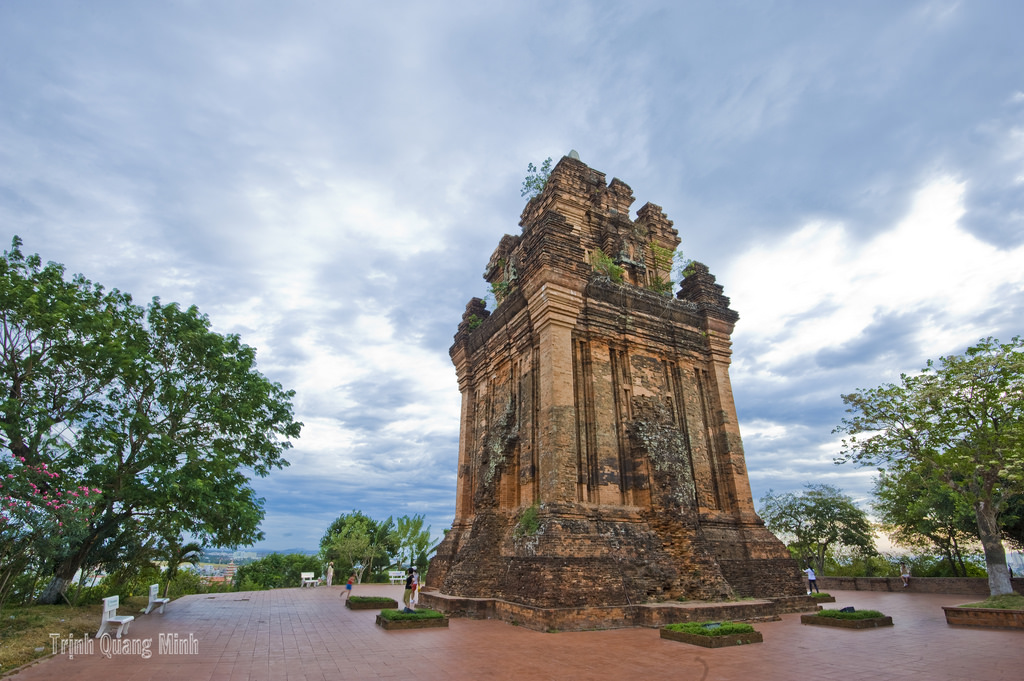
Nhan Tower on a cloudy day. Photo: Trinh Quang Minh
The tower, shrouded by old trees, is regarded by the locals as having ancient supernatural powers holding the spirits and ghosts of long forgotten times. This is holy ground and many come here to pay homage to the Gods.
Paying Homage to the Gods on Nhan Mountain. Original Photo Source: Internet
Further attractive features of Nhan Mountain
When visiting Nhan Mountain you will a get a sincere feeling of comfort and peace unlike most other places. It will not only help you understand history and religion but also provide insight into the spiritual life and social structure of the Cham people.
Even without the tower, the view from the top of the mountain makes this place worth a visit. From here you can see all over Tuy Hoa city and enjoy the calming view of this tranquil city as well as Chop Chai Mountain
Spectacular view from Nhan Mountain. From here you have the view of Tuy Hoa city and Chop Chai Mountain. Original Photo Source: Internet
A common joke is that you would rather live outside something beautiful (a palace for example) instead of inside it because then you get to look at the beauty all day while if you’re inside you only get to look at the ugly outside.
Luckily, you won’t have to worry about that with Nhan Tower as it is just as beautiful up close as far away. At night, Nhan tower is a shimmering beacon of light due to an advanced light system. Even far away, several kilometers, you can clearly see Nhan mountain shine bright in the night.
Especially, when Nhan mountain is used to celebrate cultural and recreational activities. And it often is.
To give a few examples:
A cultural performance show is celebrated from 6-8pm every Saturday
Shows and other celebrations on Nhan Moutain. Original Photo Source: Internet
Nguyen Tieu poetic festival takes place annually on the first full moon day of the lunar new year (Tet). This poetic night is the annual meeting event for poets and supporters gathering under the full moonlight, chanting the lyrical rhymes or discussing the art of poetry. You can experience these magnetic cultural activities and have a chance to harmonize with the rich Vietnamese culture.
Poetry night on Nhan Mountain. Original Photo Source: Internet
Finally, there is yet an amazing piece of architecture located on the way to the top of the mountain that shouldn’t be missed when traveling to Phu Yen. The monument is called The Heroic Martyrs Monument, is 30 meters high and stands out white under the blue sky. With its elaborate and majestic dimensions, this creative, artsy design, looks like a giant sail and should by all means not be missed.
Heroic Martyrs Monument on Nhan Mountain. Original Photo Source: Internet
Joe raised his glass and shouted “To another season!!” and emptied it. Joe is the owner of Seagarden at Otres Beach near Sihanoukville, Cambodia and today is his birthday.
For the last year or so, Otres Beach has been under the threat of being completely removed. Currently 50-something laid back chilled beach establishments fills up the space – most of them run by expat westerners that found their happiness here. The staff is a mix of locals and westerners – the guests are all foreigners. This is a place where the beer is ice-cold, the weather is hot and the weed is cheap. Showing up here for a day or two but then staying for a month or more is a recurring story.
The problem is that technical ownership of the land is somewhat chaotic to say the least and I personally have only scratched the surface about who owns what and wants who to do what.
The short story is that the entire area is threatened by Chinese investors looking to build luxury casino hotels in the area. Based on the large number of empty or abandoned casinos all around Cambodia it doesn’t seem to be a very successful plan but nonetheless many casinos are in the making.
On Koh Ta Kiev (an island off the coast of Sihanoukville and Otres beach) I asked around what the deal was with that and got various vague answers. From what I could gather, half the island is owned by Chinese and half owned by the French. The various accommodations out there are just built with a somewhat bribe-induced dubious permission which is why they never know when it’s revoked and the whole area is cleared. Furthermore, there is a large amount of free-roaming cows just grazing at will. These are apparently owned by the military and have been shifted around from island to island over the years – “sometimes the government comes over and moves some of the cows to another island – we don’t know why”. Lastly, some local fishers put some shacks on the island into an area called “the fishing village”.
To sum up: there are a lot of different forces operation out here and to me, the foreign tourist, it’s all very hairy.
Last year, the Chinese came and cleared a huge path straight through the jungle to make way for a road but then, just as quickly as they arrived, they left again. The theory is that the Cambodian government is putting pressure on the Chinese to develop these areas and apparently some sort of timeline required that there would be a road by the end of 2015 or whatever. To comply with this requirement, they just cleared some random jungle and left again. The French side remains untouched as the Cambodian government apparently are more lenient with them.
In conclusion: I don’t think anyone really knows what’s going to happen even just within the next year.
I really would love to know more about all this and not just here but also at other locations in Cambodia. Are the Chinese building Casinos against their will because of some strange arrangements with the Cambodian government? How long will we be able to drink pina coladas at these remote islands? Please comment if you know anything.
You miss the sunny beaches? The Bia Hoi? The wonderful people? The amazing food? Can’t wait for the borders to open?
Well, you’re not in luck. Not what you wanted to hear? Read on – let me explain.
What’s the problem?
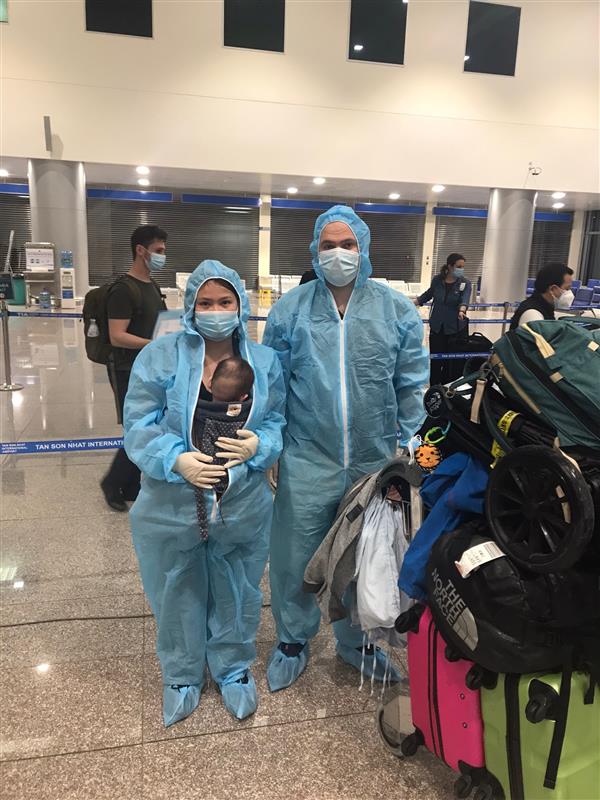
First a little back story. I’m currently employed in my home country, Denmark, and as luck would have it my company has offered me to be an expat in Vietnam. Due to this, I am right now sitting in a hotel near Tan Son Nhat Airport in Ho Chi Minh City with my wife and daughter of 8 months. We have no windows to open, we are not allowed to leave our room and we’ll be here for 22 nights followed by a strict 7 day home quarantine. It is, in all effect, a prison – a luxury prison but a prison none the less.
Why? Quarantine due to Covid-19.
Since I’m an expat I fit in one of the very few groups that are still allowed to enter Vietnam: Foreign experts and specialists. Even Vietnamese citizens have to wait months perhaps indefinitely to get in.
It’s so strict that only a few flights per week are allowed in the country, when you get there the airport is closed, as in you are the only people there when you land. We flew from Dubai and in the plane where a whopping 35 people, including first class. That’s in a 777 that can seat around 350 people.
There is a public list of every single person entering Vietnam. Go ahead, have a look.
The application process to go to Vietnam during a coronavirus pandemic
Enough chit-chat. Tell me what to do!
Alright, so as mentioned, first you have to become a foreign expert and have a reason to go here. Unfortunately, typical vocations like teaching English doesn’t count. They are very strict!
Some of the main rules include:
A title like senior software specialist. Not just a software developer or senior consultant
At least 3 years experience in the field
Have a company host you, including assignment/job contract etc. You can’t just go there and find a job.
An abundance of other minor rules
You have to make an application which takes months to handle and must be approved by the people’s committee and includes numerous original notarized papers such as your original graduate degree diploma physically sent to Vietnam as part of the application. Yes, even the original must be notarized! That’s right – your diploma will never look the same.
My title had to be approved (with physical stamps) by both the Danish Foreign Ministry, the local Vietnamese embassy and a representative union (in my case Dansk Erhverv).
They need a criminal record, marriage certificate, birth certificate etc. you name it.
And for all this? You get a 3 month visa. When you’re here, you can start all over again and apply for your workers permit since that requires physically showing up in Vietnam and for good reasons that can’t be done from home.
But wait!? That might take more than 3 months – what if your visa runs out? You extend it. More paperwork.
I won’t bore you with further details but I can assure you that I praise myself lucky that my company is taking care of this for me!
Ready to leave!
Not scared away yet? Alright. Let’s assume you did all that, got your visa, packed your bags and you’re ready to go. What to expect?
We flew with Emirates and had a 12 hour layover in Dubai which is a chapter in itself. But to sum it up, you need a negative RT-PCR test that’s no more than 48 hours old at original departure (possibly at departure in Dubai if you use Dubai Connect) and you need to send it directly to emirates who then pre-approve your certificate before you’re allowed to board.
We have a good public testing system in Denmark but they require up to 48 hours to respond and – well – that’s just not fast enough so we went with a private testing clinic.
Dubai is a surprisingly busy airport and all the shops are open by the way. Since we had a baby we were “priority” passengers and as such were allowed to board first and get driven around by those little golf-carts they have in many airports.
Well, we got in the plane (and had about 10 seats per person) and finally after a loong trip (with a baby) touched down in Ho Chi Minh City airport
Arriving in a locked-down post covid-19 Vietnam
Now, I’ve travelled a lot but this is still one of the wildest arrivals I’ve experienced. Think: If 35 confirmed cases where to tour a hospital – how would they be treated? With outmost care. The staff would be wearing protective equipment that’s for sure.
When you arrive you hand in your predeclared health card (you did that didn’t you?) and you’re escorted to the immigration counters. They are in full gear. This needs to be in your hand (not in your bag) at all times and you are regularly asked to show it.
You get your bags after a while (after they have been thoroughly sprayed by a guy with what looks like a professional fertilizer filled up with disinfectant). And proceed to another counter. You here note your name, your flight, your quarantine hotel etc. and put on full gear yourself, including sun glasses, gloves, and things for your feet.
Full gear when arriving in Vietnam – sunglasses not worn by models. It was hot!
After a while you get picked up by a car that looks like it has a kill room inside with plastic from top to bottom and you are driven to your hotel where you are again disinfected (yes you, your whole body is sprayed) and after a check in you are instructed to carry your bags yourself to your room. Lock the door and welcome to Vietnam. See you in 22 nights.
Fun detail, it used to be 14 days but while we were in here it was extended to 21 days due to a current outbreak. The people that were supposed to be arriving after we leave will have a problem with hotel availability and I guess they’re going to have to take a later flight. Also, they’re talking about completely locking down the country – even for foreign experts.
This is a series about various observations and reflections I’ve had while staying in Ubud, Bali for a month.
Gamelan– a unique style of music on Bali
Right next to our place in Ubud, Bali is an arts museum. Every day they have a gamelan performance at 7pm. It’s very loud. When they don’t have a performance – they practice; so effectively you can hear gamelan music from our home about 8 hours a day.
You’re probably wondering what gamelan music is, and you’d be right to do so because it’s only found on Bali. It’s a combination of bells and gongs and drums – basically anything you can think of that’s good at making noise. Something a child would love to have a go at. Have a listen at this very atmospheric video. For those curious about the clothes they wear and what’s going on here, I’ll be getting into the full moon ceremony I went to, in my next post.
It’s obviously played at the before mentioned arts museum mostly for the benefit of tourists but it’s also played at a variety of festivities, most notoriously at spiritual events.
A small subset of the Gamelan set-up. For this event there was over 50 musicians playing. The woman smiling at us is Wayan, the hostess of our villa who invited us here – so nice of her!
Hinduism and protective symbols in Ubud
Every day flowers with incense sticks, or jepun, are left in front of our house and every other house. The purpose is to keep the habitants safe and protect them. We have also had jepun left on our motorbike to keep with us when we drive. Jepun are placed everywhere for ceremonies and in everyday life. A friend of mine, who lives far out in a small village, has a lady come into her garden every day to leave jepun for her and she doesn’t know who it is. Apparently this lady has this as her job in this entire village – that’s what she does.
Flowers, or Jepun as they are called, in front of our villa. They are refreshed every day
The same thing goes with faces. Everywhere on decorations and pictures you see faces and heads. They have carved out coconut faces outside our villa and wooden carved faces are hanging everywhere. Bali is highly spiritual and Hinduism runs deep in every local as far as I can tell.
I will get into one of the big ceremonies they only have twice a year – the full moon ceremony – in my next post.
The Balinese and their 4-name system
Now this is a peculiar system the Balinese are using here and (to some surprise) it certainly is still very intact and functioning.
“All Balinese people are named one of just 4 names: Wayan, Made, Nyoman or Ketut. Both men and women. In Bali, Indonesia, such a 4-names-only system is entirely real and intact. Here’s how it works:
Every Balinese child is simply named by his or her order of birth. The first born, boy or girl, is Wayan. The second born is Made (pronounced ma day). The third born is Nyoman. And the 4th born is Ketut. If a family has more than four children, the cycle repeats itself, and the next ‘Wayan’ may be called Wayan Balik, which loosely translates to ‘another Wayan’.”
Balinese Children. Source: inbali.org
As a funny anecdote, I remember asking our hostess what her name was and she said Wayan. No problem. Then I asked her son what his name was and he also said Wayan. So they’re both called the same. That’s confusing. I can’t even imagine how roll call in school would work out: “Is Wayan here?” – ten people, boys and girls, raise their hands: “Present!”. Consistently, when I’ve asked what a local’s name was, I was given as answer of one of those 4 names.
Now, before you completely give up on learning people’s names on Bali there are certain things that make it easier to distinguish one person from another.
Caste name. Two different Wayans might come from a different caste. Just like we, in the western world, have family names or surnames.
Girls and boys have different honorifics before their names and as such a girl would be “Ni” – Ni Wayan while a boy would be “I” – I Wayan.
Usually a third, hindu name, with a positive meaning, is given to each child. This, combined with their first name lets them create a nickname that distinguishes them from all the other Wayan’s or Made’s.
One such example is when I asked a staff member at Hubud what his name was. He said “Budi” which is a nickname based on his hindu name “Budiasa”.
Stay tuned for the next and final of the series about Bali where I’ll be getting into the full moon ceremony!
This concludes part 2 of the series about Ubud, Bali – part 3 will be coming shortly!
I’m currently enjoying my time in Bangkok while slowly figuring out where to go next and I’m locking in on Myanmar. So much that I went to apply for a visa today and it was actually very easy.
NOTE: This is for getting a stamp in your passport before entry. This is needed if you are crossing into Myanmar over land! You can now apply for e-visa online which is good enough if you fly to Myanmar. Flying to Myanmar in general is much easier all the way around.
To and from
Take a skytrain to Surasak Skytrain Station and walk a few hundred meters to The Embassy of the Union of Myanmar. The visa office application is open 9-12 every day except Myanmar AND Thailand holidays. Due to an incident involving a forgotten passport I arrived at 9 and finished around 10:20 while my travel companion had to go back to the hostel to pick up her passport and got back at the embassy around 10:30. She finished around 11:45. This means that it takes about 1½ hours and you don’t have to get up insanely early. There were about 50-60 people in queue in front of us but the expedition for each person was very fast (<5 minutes) and there were several counters. We were there on a Tuesday.
What you need
Your passport and money that’s all you need. about 1400 bahts will get you visa the same day, 1250 baths will get it to you the day after and the budget solution will get it to you two days after for 800 bahts. I opted for the last option. Be mindful that you will not have your passport in that time, so make sure you don’t need it for anything.
Other than that you can bring two passport style photos (any kind really – they seemed very easy with shape/size/color etc) and a copy of your passport if you have it. If you don’t have those things they do it there for you. 8 photos is 100bahts and a copy of your passport is 3 bahts.
You also need and application which is one paper (double sided) and very easy to fill up. You need to write some basic information, your present and current job and the place you stay in Myanmar. If you haven’t figured out yet where you are going to stay, just pick any hostel out of a guidebook or ask the guy next to you where he is staying (that’s what I did). Furthermore it’s worth noting that if you get something wrong, they help you at the counter. You don’t have to go to the back of the line.
Getting back the passport
When you apply for the visa the day before you get a yellow receipt – keep it! You need it to get your passport back. I don’t know what happens if you lose it – but you probably shouldn’t 🙂
Depending on which option you chose you will then have to get back the same day, next day, or the day after respectively between 15:30 – 16:30. Pick-up is swift and the wait is long. Remember your yellow receipt!
I had previously reached out to Dave from Dave’s travel corner who owns a house in rural Thailand in a small “village” (consisting of now only 3 houses) in Prachinburi province, about 2 hours drive east of Bangkok along route 304. Dave lives there with his wife Syy and when he is not in Thailand he is either at his base in California, or he is out travelling (to Antarctica just to name one he’s already got planned)
Dave in his “office” beneath his house
The area in Thailand boomed over the last 5 years due to paper making business’s moving in which means there is now actually a city nearby and more than one place of accommodation. As a side-effect this also puts a certain smell down over the nearby area that probably takes some getting used to. Luckily neither the hotel I stayed at or Dave’s house had any smell when I was there. It is still a sleepy town and when I asked Dave what kind of people would just randomly drop by here, he answered “no one”.
So what do you do in a town like Dave’s
I arrived from Bangkok in the afternoon on a Friday and was due to leave two days later.
The town didn’t disappoint me and neither did Dave. There was no Eiffel tower or reclining Buddha to see but there was a fishing pond, a scooter drive to a nearby delicious noodle store, and some drone flying. Dave has made an excellent edit of the drone flying footage. We managed to crash it a few times but it survived and gave us some interesting footage of Thailand from the sky.
Finally, of course, I spent a lot of time talking to Dave about everything travel – blogging, travelling, packing, anecdotes from foreign countries and everything in between. Compared to this guy I’m a fledgling traveller barely having touched the world while Dave has somewhere around 130-150 countries under his west– he’s been going at it since 1996. So needless to say he had a lot of knowledge to drop on me.
Moving on
I had two very good days with Dave and Sai, hanging in the hammock and enjoying the serene life of rural Thailand. Especially after 4 hectic days in Bangkok, this was a welcomed break! I could easily have stayed a week more, just doing nothing and absolutely loving it. However, all good things must come to an end and Dave and Sai had to move on. After having pursued alternative methods to get to Myanmar by land we realised there was only one way and that was to go back to Bangkok and take a bus from there. At least I could share the first leg with Dave and Sai as they were heading to Bangkok as well.