|

Hitchhiking solo from Germany to Denmark

Making the decision to hitchhike

After Wacken Festival in Germany (near Itzehoe) I needed to get back home to Copenhagen and for various reasons I decided to hitchhike – approximately 450km’s.

The first part of the trip was easy as I was at the festival with a friend and he took me as far as Schleswig (100km’s). This also gave me a welcomed chance for a decent meal and a shower. Between the time it took to pack the camp, drive to Schleswig and get ready to continue my journey it was already 5pm.

Originally the plan was to sleep at my friends’ place and leave early next day to have a full array of daylight. However, from a mix of wanting to push my limits to wanting to get home earlier, I left the same day.

hitchhike
The familiar “thumbs up” signaling a desire to hitchhike

Step by step progress of the day

17:00 – I was dropped off at the highway on-ramp towards Denmark. After about 10 minutes I got picked up by some guys who could take me to Flensbourg – 30km’s north. It wasn’t a long ride but I reasoned that it would take me closer to the border and at the same time provide a roof over my head as it started raining and I had no shelter at my current position. Looking back, it wasn’t a good call as they took me all the way to the center of Flensbourg – about 15minutes from the highway.

18:00 – I asked an old couple to take me back out the highway and they did. Unfortunately, it was at an on-ramp coming from a cars-only road. This meant that there was no place for me to stand and even the on-ramp didn’t have much place to stop. I’m also fairly confident it was illegal.

19:00 – After a demoralizing hour a car stopped – a local car going back to Flensbourg. He said that I probably wasn’t standing in a very good position (to which I agreed) and suggested he take me to the nearest McDonalds: “many Danes park there, maybe you can get a ride towards Denmark from there?”

As it was once again raining and I had realised that I had forgotten my rain jacket at my friend’s house, I agreed. This meant that after a couple of hours I was only about 30km’s closer and I was stranded in an inconvenient place with little traffic away from the highway. Fortunately (!), he made me a very generous offer of coming back for me one hour later and if I were still around he would take me to the nearest rest stop on the Danish side of the border to help me on my way.

20:20 – No one was able to take me – they were either locals or vacationing families with full cars. Naturally, I was at a low point as this wasn’t exactly what I had hoped for. However, my friend from before, Michael, heroically returned to save the day for me.

20:50 – He dropped me off at not the first, not the second but the third rest stop in Denmark for the sole reason that the first two were too small with not enough traffic. If you look at the map at the top of this post, you’ll see it’s quite a way up into Denmark. This guy was a true hero.

20:51 – Approximately one minute later I got another ride from a Polish guy going north towards Aalborg. Although not the right direction I figured he could take me another 50km. In retrospect, this was a mistake.

21:30 – As we were nearing the place where the highways split (he needed to go north, I wanted to go east) he had to drop me off. Unfortunately, there was only a small rest stop before the intersection. This meant that although I was closer to home, I was now in a position with much less traffic.

21:35 – I got a ride from a German couple and their baby. They also needed to go north but they could see from their GPS that there was actually a gas station closer to the intersection before the highways split and there I would be able to get more rides, so I accepted. Again, looking back this was also a bad call and although it was closer and a gas station, it was a gas station a little bit away from the highway with very little highway traffic.

21:45 – It was getting dark and cold and traffic was dying. I tried different things, I walked to the highway onramp, I asked everyone at the gas station and I even got a ride to a nearby truck terminal to ask if anyone was going my way by any chance. They weren’t – they were all going south although, for the record, as much of a longshot as I thought it would be, I could have probably have gotten a ride if I was going that direction.

23:15 – I had been standing at the on ramp for about an hour and a few cars had stopped but they were going very short distances as well as the wrong way – so no luck. About to give up, I checked the train schedules which were horrible for getting home. My last resort was to go back to the gas station and ask if I could sleep in the back room somewhere until the next morning and then try again.

23:25 – I was back at the gas station and was approached by a guy with whom I had a conversation roughly like this:

Him: “are you a hitchhiker?”
Me: “yes…”
Him: “are you going to Copenhagen?”
Me: “uuhm, yes…”
Him: “Congratulations, you’ll get home tonight.”

*high five*

As it turns out, it was a car filled with hitchhikers coming directly from a festival in Amsterdam for street performers, entertainers, jugglers etc. as well as their tools of the trade. I managed to squeeze in and off we went.

If you ever needed proof for the existence of Karma – this would be it. Right there in my hour of need, these friends magically appeared. They were only there because they had to drop off a friend off at this very spot.

02:15 – Following a pleasant and very interesting talk in the car I arrived at my front door safe and sound.

Conclusion

After a very long day, following a long festival, I made it home. At times, this trip was rough but I made it in the end and the good times massively outweighed the bad times. Update: one week later I hitchhiked from Copenhagen to North Jutland in about 8 hours – much faster. Especially considering that 1hour 30 was from the ferry ride across and another 1hour 30 was waiting for the ferry at the terminal.

Also, looking back, a very important lesson here is that getting closer to your goal is not an advantage if it takes you away from traffic. I should not have taken that ride from Schleswig to Flensbourg city center and I should not have taken either of those rides that took me first from the main gas station to the smaller rest stop and then again to the small gas station away from the highway. I got picked up by a Polish guy going north after just 1 minute and if I had just been patient and waited for that one car that went all the way to Copenhagen or at least Odense (a long stretch towards the right direction), I’m sure it would have gone a lot smoother.

hitchhike open road
The open road. Stick your thumb out and enjoy some of that rural bliss

Similar Posts

  • | |

    #VanLife – A new adventure awaits!

    This is post 1 of 1 in the series “Vanlife”

    Vanlife

    Yes, that’s right. I used a hashtag in the title. These are strange times.

    Anyway, I have been living that suburban life and unfortunately that meant that I didn’t feel too inspired to write. I mean, we – my family and I – travel, I love travelling but there’s just not time to also keep up the blog. Yet, here we are.
    So what inspired me this time? You might have guessed it based on the #Vanlife hashtag. The fact is…

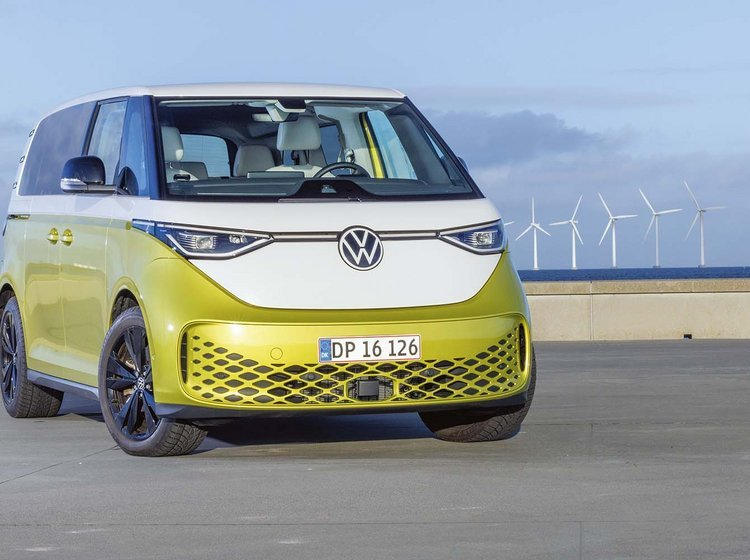
    We bought the electric VW ID.Buzz MPV

    Yellow and white VW ID. Buzz parked by the sea with wind turbines behind

    What is the VW ID.Buzz?

    Wikipedia has this to say:

    “The Volkswagen ID. Buzz is a battery electric minivan produced by German manufacturer Volkswagen. Based on the dedicated battery electric MEB platform, it is the first production electric minivan from Volkswagen and part of the Volkswagen ID. series.[4] The design of the ID. Buzz is inspired by the Volkswagen Type 2 (T1) Microbus.”

    Hmm. Great. While true, it’s not exactly riveting. What won my heart about the Buzz is the fact that it’s a revitalisation of the old volkswagen T1/T2. Colloquially know as the hippie van or the VW bus. In Denmark, where I’m from, it’s also called “folkevognsrugbrødet” which is almost impossible to translate. “Folkevogn” is the Danish translation of the German word “volkswagen” which roughly translated means “people’s van” – while “rugbrød” is a type of dark heavy bread enjoyed in Denmark. It’s heavy, cheap and keeps you going through hard work. Similarly, when you’re biking, you’re using your “rugbrødsmotor” or your “rugbrødsengine” to power the bike. Put all that together and you get a car that’s like a people’s van that keeps on going. A work horse accessible to all.

    But I digress, besides the history, it’s beautiful with it’s big smiley front, large logo and welcoming headlights. It’s also functional, spacious and just all around joyful to drive. I’m not trying to sell you this car but I want to put my enthusiasm down on paper for all to see.

    Where does Vanlife come into all this?

    Yes. Vanlife. It’s because I want to use this car as both our primary (and only) vehicle in the family and as an every day adventure facilitator. It’s already set up for this from Volkswagens side and although it’s not a campervan per se, it’s definitely usable in that domain.

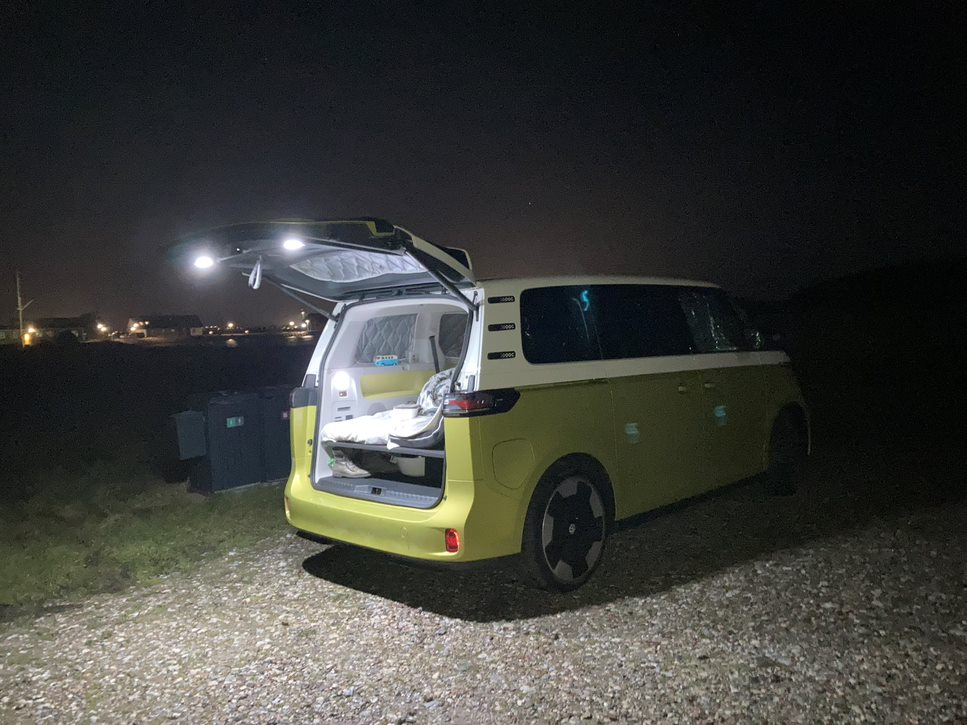
    In fact, all though it’s winter and negative degrees (celcius) here in Denmark. I’ve already taken out the van to wild camp (camping for free on random parking lots etc).

    VW ID. Buzz with the tailgate open, lit up at night at a wild camping spot in Denmark

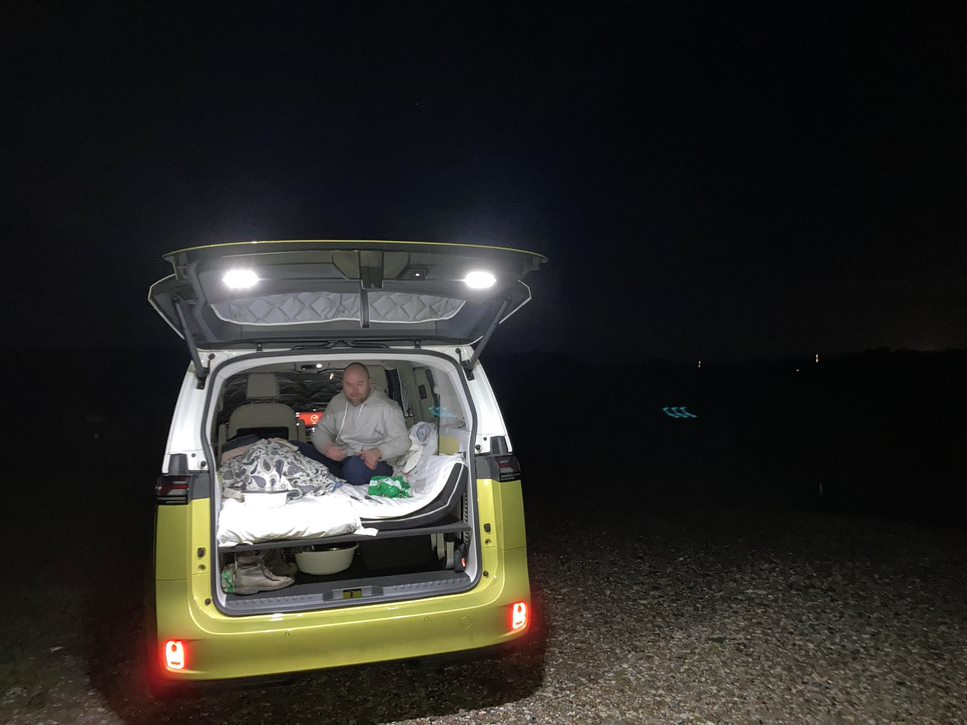
    It worked quite well. Being electric it gives you lots of power to enjoy. We spent around 10% battery keeping it warm all night.

    Sleeping in the back of the VW ID. Buzz at night with the tailgate open

    We haven’t figured out all the small details. As you see, the mattresses are 140cm wide, while the car is only 120cm so they don’t totally fit. We also need to buy camping gear. We have a Jackery 1000W Explorer pro battery that can run an electric stove and some other minor gear. It all fits under the split seat so that you have a lot of free space in the main “sleeping cabin”. However, we still need maybe a fridge, some boxes to compartmentalise stuff, an awning on the side, some chairs and a table etc. Whatever it takes.

    However, as this is also going to be used as a normal every day car, we’re not going for a full rebuild or permanent installations.

    What’s next?

    More adventures, more gear, more stories and anecdotes, and more posts right here on worldwidewinther.com

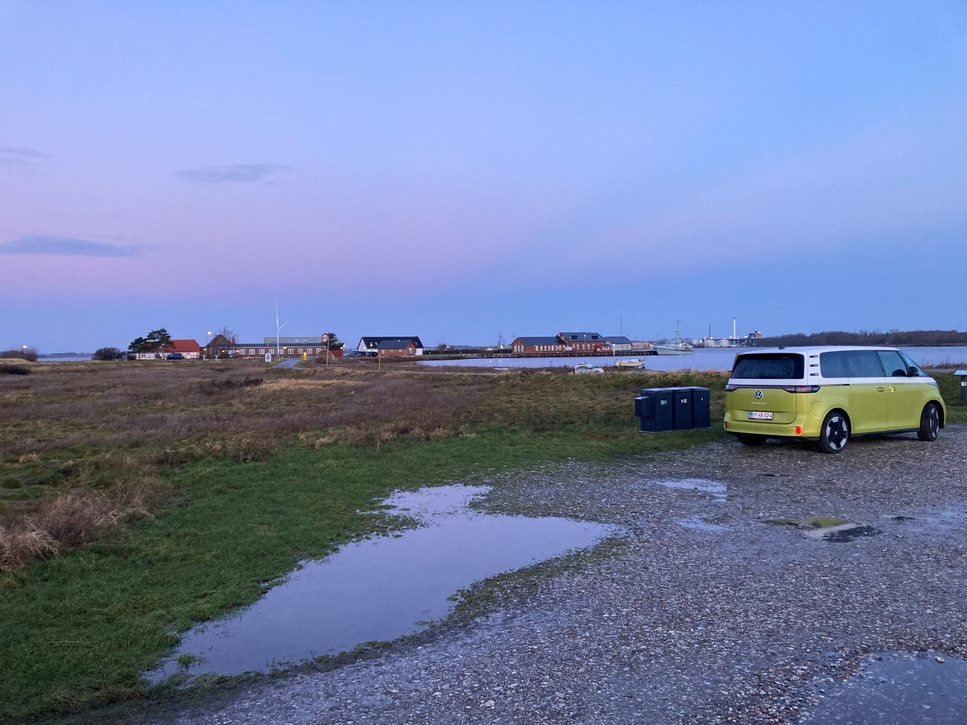
    VW ID. Buzz parked on a gravel spot by the water at dusk

    Stay tuned!

  • | |

    Using the smugglers route to cross from Vietnam into China

    In May 2016 I visited Lung Cu all the way up the most northern part of Vietnam but this is not what this story is about

    After Lung Cu I thought it would be cool to see the border here. I’m drawn towards the border because I’m intrigued with the idea that a border to a country as closed as China would be completely unsupervised. I’ve always had this idea of a completely remote border, you know, without even a border control post where only shepherds roam somewhere deep in the mountains.

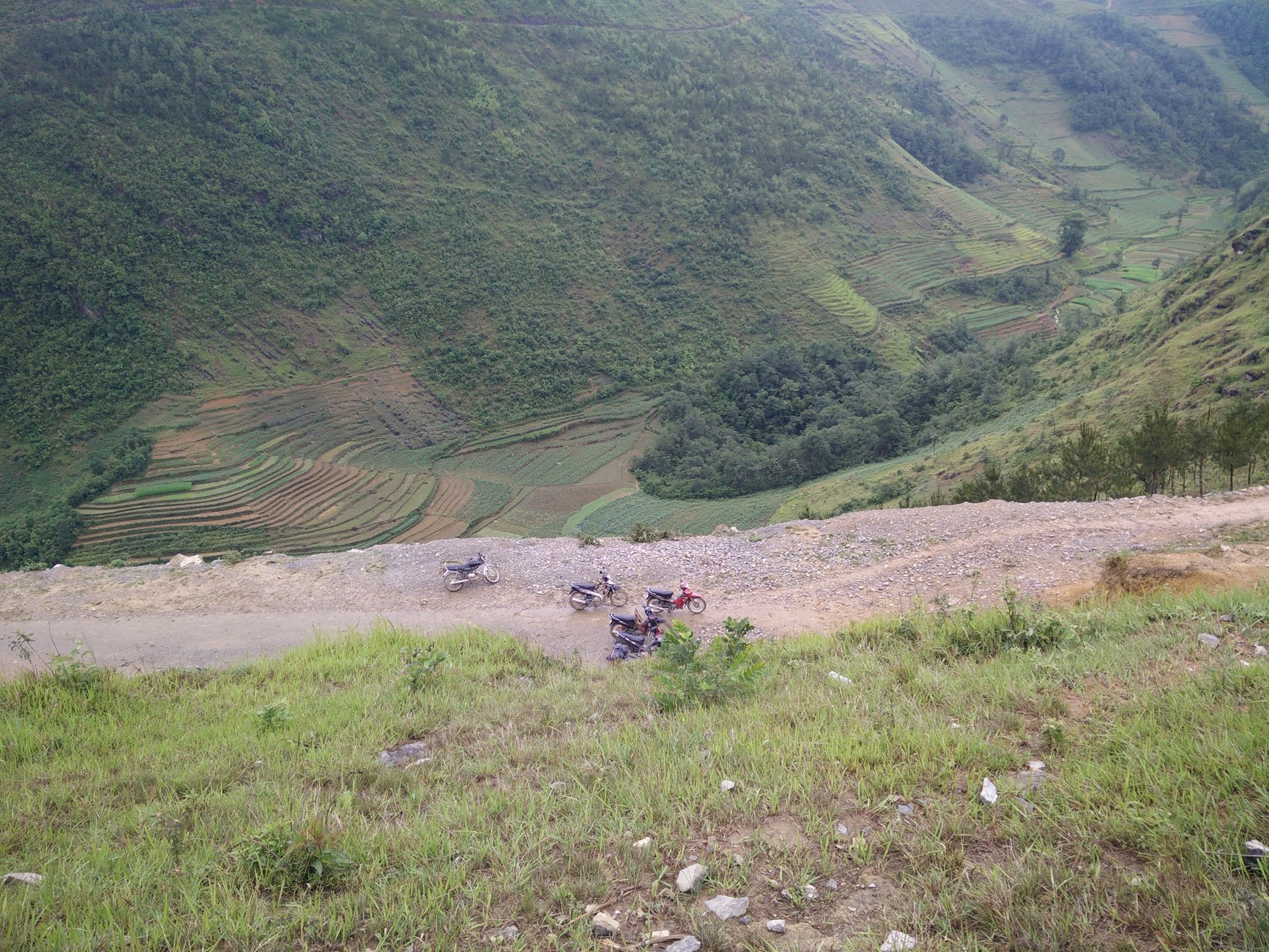
    As I drove out the road the pavement suddenly stopped and before me was about 6 motorbikes and a tiny dirt path along the ridge of the mountain. It looked like something you would only want to walk and the direction took you straight towards China. This is it I guess – the border.

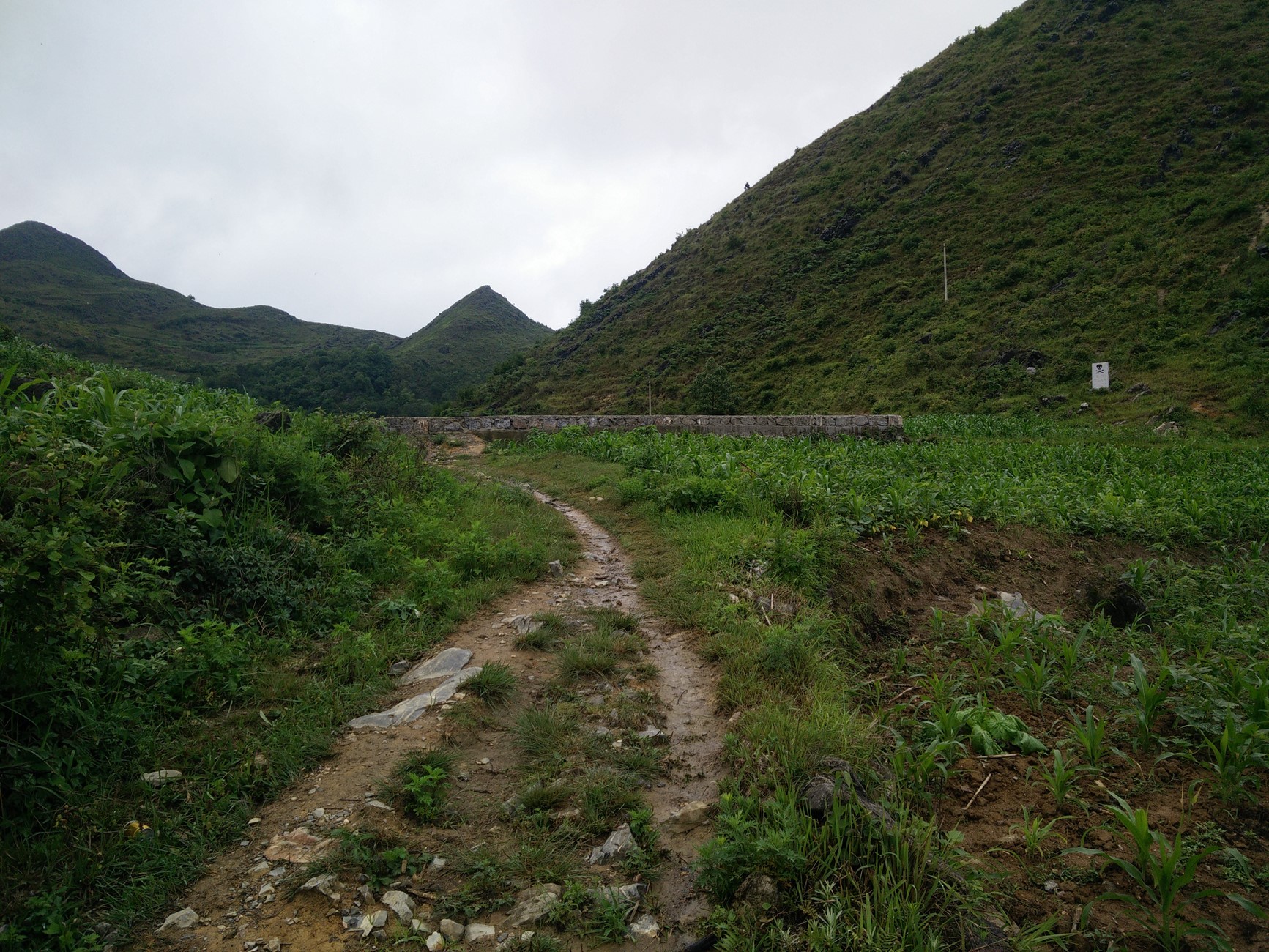
    I could see pretty far ahead and it looked like at least a 15-minute walk down along a very muddy path before anything would change so I decided to opt against it. However, as I turned around a little bit I noticed a definite path going up the mountain, not towards China, so I figured it would be safe to go up there, at least for the view over the valley.

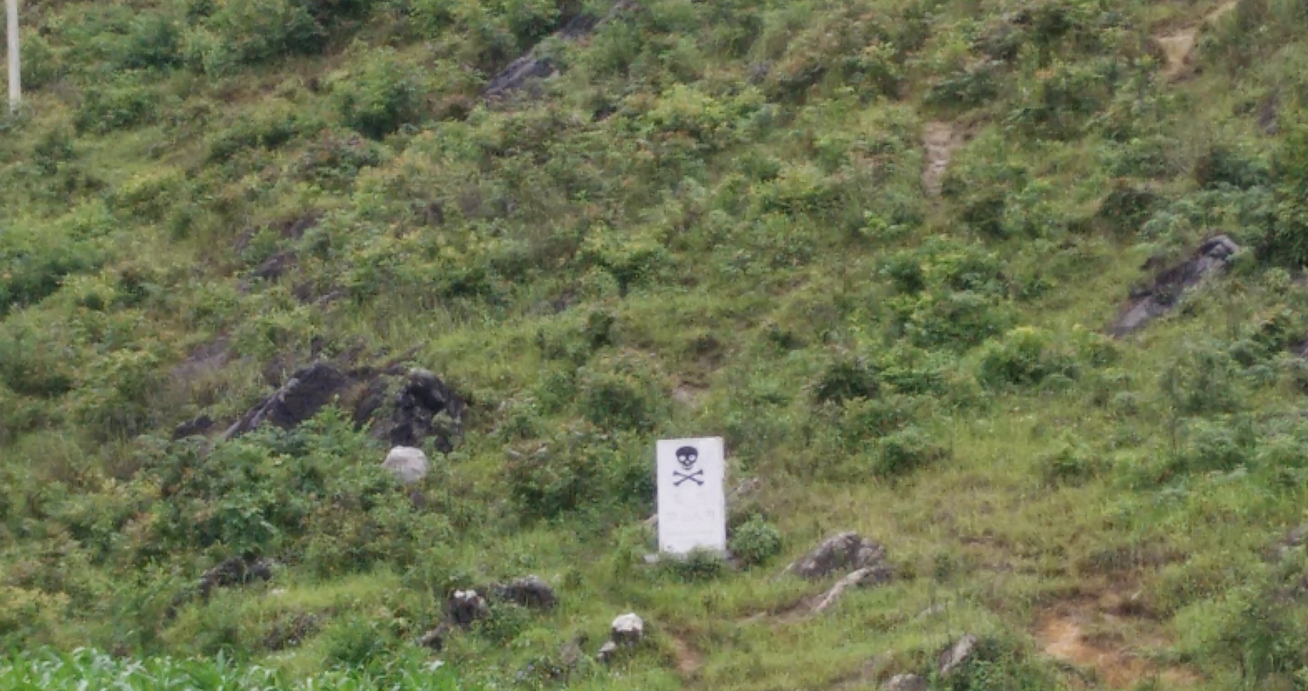
    When I got up I saw several road marker stones with skulls on them all over the area. Skulls, just skulls. Frightening.

    Border marker stone with a skull and crossbones on a green hillside near the Vietnam-China border

    Thoughts of land mines and stuff like that popped up in my head and I was about to turn around. Enough is enough.

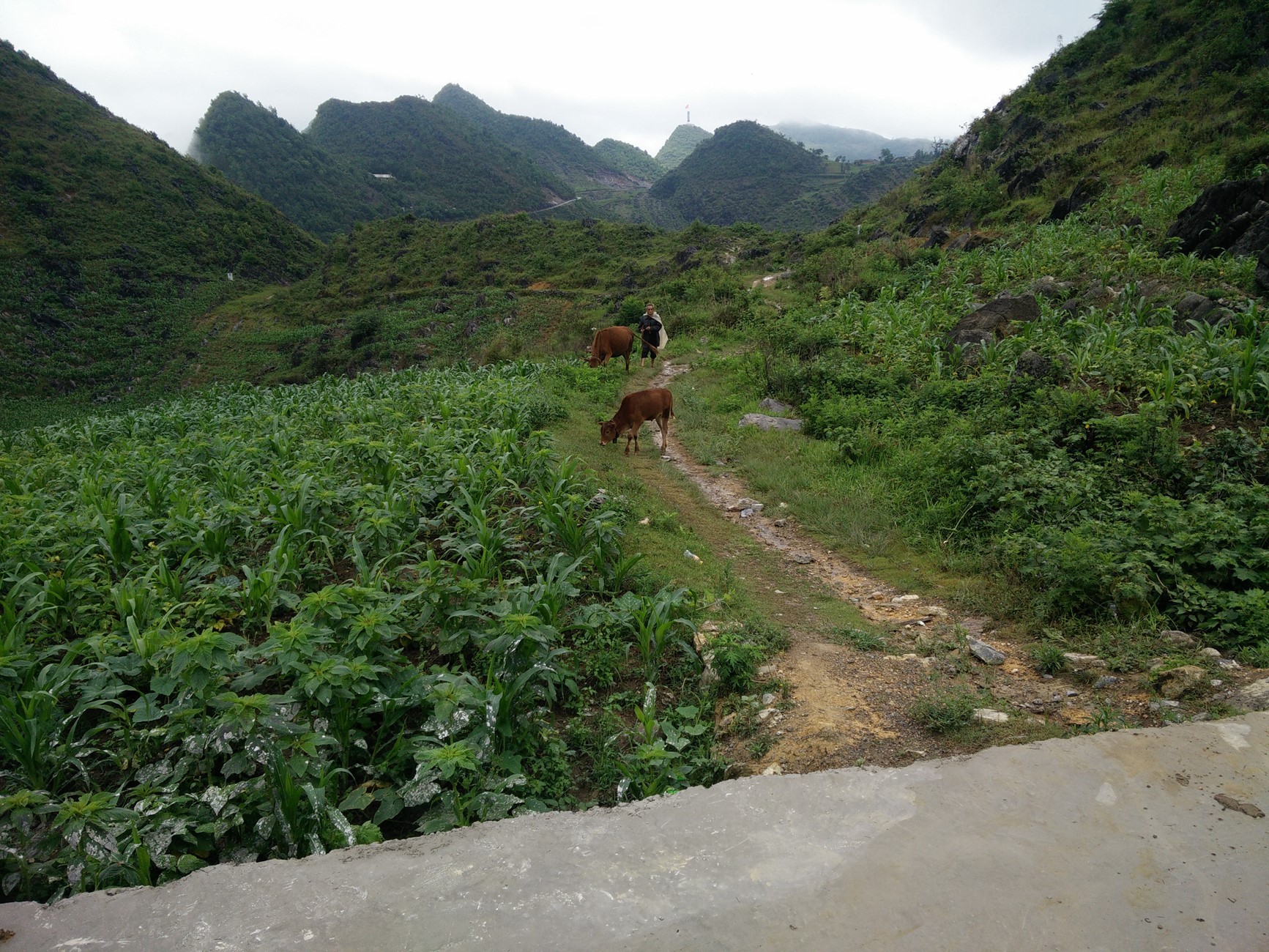
    But when I was about to turn around I saw a shepherd with two cows on a definite path, albeit small, meaning that at least it would be safe, landmine wise – and so I continued towards him.

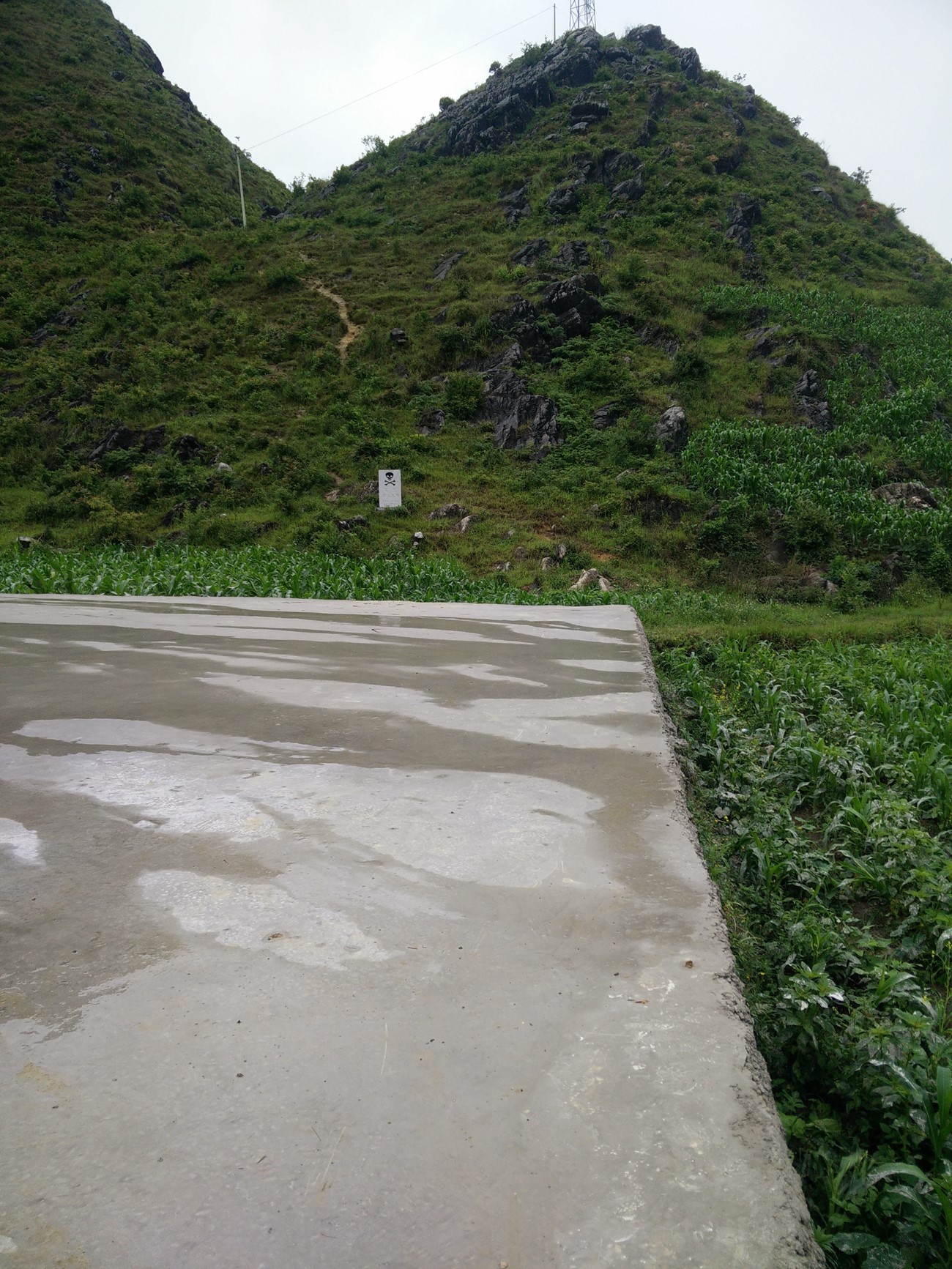
    Around the corner I saw a paved road pop out in the middle of nowhere, Chinese signs and more skulls. I’m pretty sure this was the border. I walked up on the pavement, talked some with the farmer – who was Chinese! – and walked back to my bike.

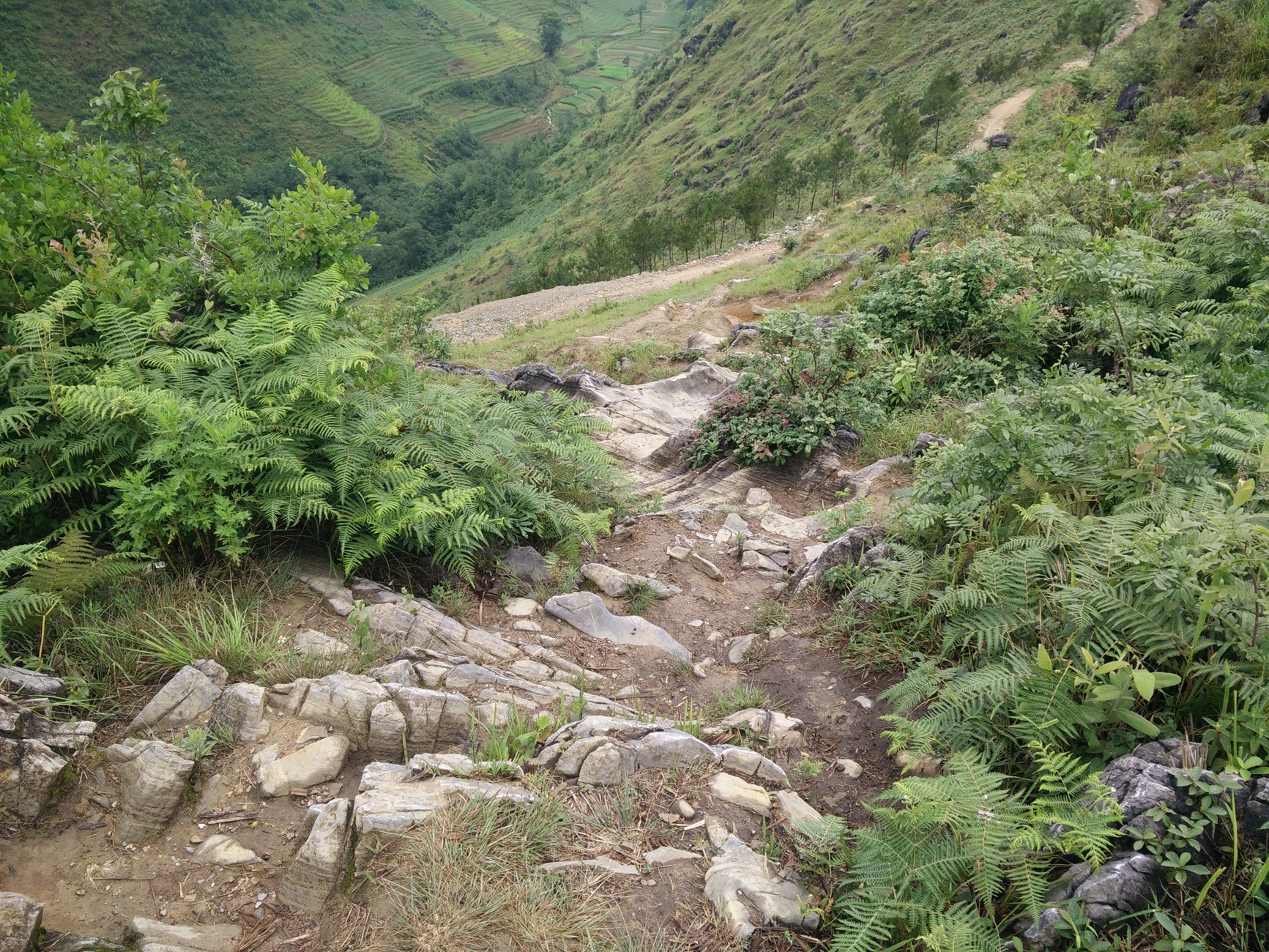
    Motorbikes on a dirt road above a green valley with terraced fields near the Chinese borderDirt track leading into green hills near the Vietnam-China borderCows grazing by a narrow track between green karst hills at the borderConcrete path ending at green hills on the smugglers routeRocky footpath down a fern-covered slope on the smugglers route

    On the way out, with mud all over my shoes, I got some concerned looks from locals who could only wonder what I’d been doing out there. I’ve heard from other people that the area is used for smugglers as well – which would make sense since it’s so easy and remote.

  • |

    Monaco and Liechtenstein has been checked off

    Europe was once ridden with independent mini-countries but now only a few remain: the mini-states of Andorra, Luxemburg and Liechtenstein as well as the city-states of Monaco, San Marino and the Vatican City with the latter serving as the Catholic Pope’s residency.

    During my latest and current roadtrip (I’m writing this from Portugal) we passed through first Liechtenstein and then Monaco. Both are interesting places!

    Europe was once ridden with independent mini-countries but now only a few remain: the mini-states of Andorra, Luxemburg and Liechtenstein as well as the city-states of Monaco, San Marino and the Vatican City with the latter being the serving as the Catholic Pope’s residency.

    Liechtenstein

    Liechtenstein is a country about 25km’s long, making it large, as far as mini-states go. It is situated in the mountainous Alpes between Switzerland and Austria.

    We arrived here at 1am and looked around. Even in the dark moon-light, you can feel the charm of this city with winding roads and small shops.

    High above the centre of Vaduz (the capital) is visible a highly picturesque castle. Unfortunately, you are not allowed to go inside the castle (even during the day) as it is a private residence. The prince of Liechtenstein – Liechtenstein is a Monarchy – still lives there.

    Furthermore, it has excellent winter sport capabilities and has through a long period of time served as a billionaire tax haven. However, in the recent years, the country is no longer blacklisted as a tax-haven but still bolsters the highest GBP per capita in the world (meaning everyone living here is filthy rich!).

    The castle in Vaduz, Liechtenstein where the Prince lives
    The castle in Vaduz (capital of Liechtenstein) at night. The castle is not small. It stretches far behind what is visible here including several (modern) wings.

    Monaco

    Of the two, Liechtenstein gives off a secluded private haven in the mountains best suited for people wanting to take a break from an otherwise hectic lifestyle, while Monaco gives off a vibe of all the things your mom says you shouldn’t waste your money on: cars, girls, yachts and casinos.

    Monaco is a city state located on prime real-estate on the French Riviera overlooking the Mediterranean Sea. It is about 3.5km’s long, meaning that it’s basically just a bay and that you can see from one side to the other from the beach (or from your yacht if you prefer). This makes it the second smallest and densest country in the world.

    Monaco, like Liechtenstein, is a monarchy with a sovereign Prince as head of state with immense political power. It’s noteworthy that a single house, the house of Grimaldi, has ruled Monaco (with brief interruptions) since 1297! While Liechtenstein has the highest GDP in the world, Monaco comes in at a close second.

    The reason for this are favourable tax laws, luring wealthy people from all over the world to the country as well as a sprawling gambling industry started with the opening of the famous (or infamous) Monte Carlo casino in 1863.

    With exuberant social persons, quiet philantropists, casinos and the charming French Riviera combined with agreeable weather this place is currently a very lively place with all of walks of life enjoying their existence here. You’ll see helicopters in the sky and yachts floating outside the coast (all private, of course) topped off with an all you can eat buffet of expensive cars.

    You’ll see more exotic cars (new and old) within a day here than at any car conventions I’ve been to. If that picture doesn’t convince you, consider this: at any time and at any place – if you look around you’ll see a car worth turning your head for.

    Of the two, Liechtenstein gives off a secluded private haven in the mountains best suited for people wanting to take a break from an otherwise hectic lifestyle, while Monaco gives off a vibe of all the things your mom says you shouldn’t waste your money on: cars, girls, yachts and casinos.

    Monaco with monte carlo casino, yachts and beach
    Monaco seen from above. You can see the Monte Carlo Casino and one of the monstrous yachts in the background. There’s a beach behind there as well

  • |

    Taking the plunge: Quitting to pursue a life of travel

    This is post 3 of 3 in the series “Denmark”

    1. Offline blogging
    2. Traveling at home
    3. Taking the plunge: Quitting to pursue a life of travel

    Taking the plunge

    November 30th 2015 I walked into my boss’s office with a letter of resignation. December 23rd I had my last day of work. Today, at the time of publishing this post, I’m sitting in Helsinki Airport on a 3 hour layover; with a one-way ticket to Bangkok, “taking the plunge” is in full effect. But let’s start at the beginning.

    I have always loved travelling. I’ve been travelling many times every year since I was a kid and during my university years in Denmark I spent three semesters abroad in Phoenix (Arizona, US), Troy (New York, US) and Karlsruhe (Germany) so coming out of university I was no stranger to travel or spending time abroad several months at a time. During my younger years it was mostly ski holidays and weekend trips to big cities of Europe. I also went on a couple roadtrips around Europe and some international festivals. But despite actually having spent many weeks of my life abroad I had only ever been to two continents: North America and Europe. In other words, by age 25, I had only really experienced western culture – albeit a lot of it and a good starting point for further explorations..

    The first bite of travelling

    Between my first and second job I spent 2½ months travelling almost full time. Greenland for two weeks, Ukraine/Moldova for two weeks, Sweden for one week and a couple of other minor trips. This was where I experienced the faint bite of the travel bug for the first time. I enjoyed these trips so much and I met so many people that there was really no going back. Although at the time, when I was about to start working again, I was thinking: “Oh well, you’ve had your fun – now get back to work and start acting like a grown up and get a job instead of living in a dream where one can travel for ever and cash is never an issue”. And so I started my new job.

    Eagles on my arms in Ukraine
    4 eagles taking a “rest” on my arms in Odessa, Ukraine.

    Building my career

    At first my second job was amazing, I got thrown out into the deep end of the pool with my assigned mentor quit leaving me very alone to take care of things I had no idea how to do. On top of that I went on business trips with the company and therefore got to travel a lot. This was a very exciting time of my life and at that point I could see myself doing it for a long time. However, after about a year and a half the travels stopped. I got slowly pushed into a more expert like role with a less broad profile.

    For my career this was all good and I definitely had a bright future continuing this job but the longing for travel just kept increasing until the point, after a very pivotal conversation with a good friend, when I realized that I had to make a change. Luckily I got the possibility of a 3-month stay  at our department in Malaysia.

    Those three months were spectacular and by using some vacation I also got to travel solo around South East Asia. The only downside was that when I got back I wanted more. With the 2 months of travel a few years back, a 3 week intense trans-Siberian railroad trip and this latest trip to Malaysia I had been exposed to not only solo travelling but also long term travelling and last but not the least, a vastly different culture than what I was used to, I could only think about my next trip.

    Some reflections about quitting

    During all our lives, well at least most of us, we have been socially programmed to “do the right thing”. That is to go to school, get an education – as academic as possible, get a job, raise a family, take a loan, buy a house, buy a car, buy a dog, all while paying into your retirement fund so that you can die of old age in comfort. Not necessarily in that order.

    Economics

    All those thoughts go through your head the time before quitting and especially 5 minutes before you quit: will I be able to get a job when I get back, will my career take a serious blow, what about my pension (since I’m not working), what about my friends, what about my family, what about my house, car, tv, lawn chair or whatever else you may dearly possess. What about all of it!? And even when you have convinced yourself that all your worldly possessions will be safe as well as your future potential to gather more trinkets (read: your career) will also survive there is still the very immediate and unavoidable fact that travel ain’t free and somehow someone will have to pay for the whole shebang.

    The topic of “how much money do I need to travel” is a question asked by almost everyone and answered almost as many times but not by me right now as that is enough material for a full post. But in short you don’t really need that much. Check out this post made by Nomadic Matt about this very topic. Many people have started travelling by initially just going away for a week’s vacation and then just never returned because they saw an opportunity to stay and seized it. An example is a friend of mine from the UK that went to Thailand for a 10 days’ vacation and while there got offered a job to teach English. 2 years later he is now in Malaysia instead (still teaching English) and has no immediate plans or need to return home any time soon.

    Being Lonely

    Another very pressing topic is loneliness which I got a bit into in my post about Penang. I’ve been on four long term stays abroad and not until the last and final one did I experience being lonely. The first three were all as an exchange student while the latest one was a business trip. Being away on a business trip and living in a hotel for three months was a great experience that I wouldn’t take back. However, even though your colleagues are awesome and often go out in the evenings and weekends to do things with you, you still miss your friends. A third way to travel is the way I’m going now: full time travel, constantly on the move. This is unlike anything I’ve done before (for more than a month) and from what you hear through the grapevine it can and will get lonely at times. Even though you are constantly surrounded by interesting and unique people you will have to endure a lot of goodbyes which can take it’s toll on anyone.

    Outside your comfort zone
    Where the Magic Happens

    These are just a subset of things that have been on my mind over the last 2 years and especially the last month. People who know me will confirm that I can easily spend hours talking about travel – in a more or less rambling fashion. But no matter what happens I’m completely certain that I will look back at this experience and be happy that I did it. Travel is the best education you can get.

    The next steps

    All of January I have been planning and preparing to get ready and by the time of publishing this post there will be nothing left to do than to board the plane to Thailand. Even with a month of preparing, I have a very vague idea about what I will be doing when I get there. I have set up to meet with two bloggers and I have talked to a couple of friends about meeting up with them (or their families) but nothing is written in stone. Once again I will be in the deep end of the pool – taking the plunge.

    view over the green fields of Mongolia
    View over the endless fields of green from the top of a mountain in Mongolia

  • Long term travel Insurance

    You’ve decided to go long term travelling and you are looking at long term travel insurance. This can be tricky and is something I spent some time on. First of all there is the difference between travel insurance and health insurance.

    Types of travel insurance

    • Single-Travel travel insurance is something you get for a set period of time. You have health insurance in your home country but it doesn’t cover worldwide travel so you need to expand your insurance. Usually your normal insurance company offers a solution for this. What it covers is smaller immediate healthcare needs (like medical attention when you get food poisoning) but also and more importantly – your trip home. You will then be getting taken care of in your home country.
      • Pros: You can take care of everything before you leave and not worry about it again (unless you overstay your pre-set period of time).
      • Cons: You both need to know (roughly) how long your travel is and you need to pay up front. It is hard to extend and in general less flexible. Just offers a plane ticket home unless it’s a small illness. Moderately Expensive
    • Yearly based travel insurance is running continuously all year through your normal insurance company and covers all travels you go on and you pay even if you don’t leave the country. This type of insurance usually covers all travels you go on – short, long, extreme and you don’t have to deal with insurance every time you go travel. There are, however, usually restrictions so that your travel cannot be longer than 2 months before you have to return home and just like with single-travel travel insurance you get a plane ticket home unless it’s a small illness.
      • Easy, simple, always active, cheap
      • Travel restrictions for travels over a certain period of time (usually around 2 months). Just offers a plane ticket home unless it’s a small illness.
    • World wide health insurance is the full deal, not just a plane ticket home but actual health coverage worldwide. With this you won’t be getting a ticket home paid by the company but the actual hospital bill wherever you are. You can also extend it on a monthly basis.
      • Pros: You won’t need to know your return date or length of trip. You also won’t have to end your trip unwillingly if you extend your stay longer than originally planned or need hospital care half way through.
      • Cons: Expensive, you might have to deal with two insurance companies (home and worldwide)

    Which travel insurance to recommend?

    For trips shorter than a month or two, or for trips where you know your end date I would recommend normal travel insurance. Call your current insurance company and ask what a travel insurance costs. Personally mine is about $100 year and I’ve had that for many years. As long as I don’t travel more than 60 days (on one trip) I will always be covered on my travels and I’ve always travelled a lot making it an easy decision to maintain this insurance.

    For longer trips it get’s tricky. My current trip is without an end date meaning that I will pass my 60 days. This means I will need actual worldwide health insurance and not just “travel insurance”. Alternatively I could come home every 2 months and keep the cheap insurance as I would technically start a “new” trip every 2 months (note: I don’t know if all insurance companies sees it this way but for mine: I just need to be home a day to “reset”). Seeing as my travel insurance is $100/year and worldwide health insurance runs at about $100/month it actually almost makes sense, moneywise, to just go home every two months. However, personally, I don’t want to deal with the hassle of interrupting my travels all the time. Ultimately I’ve chosen to have both yearly travel insurance and worldwide health insurance.

    If I do decide to visit home I can use my yearly travel insurance for the first two months after I leave again and save the money I would have otherwise spent on the worldwide health insurance. After two months I activate my worldwide health insurance again and travel as long as I want. I save a lot of money but the downside is that I will have to remember cancelling and activating my worldwide health insurance.

    Overview chart

    For other travel insurance companies and for a great overview (no really), check out this chart:

    Conclusion

    There are many choices out there for you and the topic is not easy to wrap your head around. I’ve written about some of the problems you will run in to and what I’ve consequently ended up doing. It offers the cheapest solution while maintaining flexibility.

    Please don’t hesitate to contact me or comment on this page if you have any questions!

  • Odessa, Ukraine: Part 1

    This is post 1 of 2 in the series “Ukraine”

    These posts describe my extended weekend to Odessa in Ukraine

    1. Odessa, Ukraine: Part 1
    2. Odessa, Ukraine: Part 2

    Dette indlæg beskriver min seneste rejse: København->Moskva->Odessa->Moskva->København.

    Hvorfor Ukraine, og hvorfor lige nu oveni alt den politiske uro tænker du måske? Svaret er at i løbet af min forrige rejse til Moldova/Ukraine fik jeg gentagende gange at vide at Odessa er en virkelig dejlig by, faktisk den bedste i Ukraine, og hvis jeg virkelig vil se den gode side af Ukraine, så tag derhen. Samtidig havde jeg booket biletterne inden problemerne opstod. Efter at have spurgt på couchsurfing og et par ukrainske venner jeg kender blev jeg hurtigt overbevist om at der ingen problemer var i Odessa.

    Inden rejsen overhovedet startede, havde Aeroflot (et flyselskab kendt for at lave uannoncerede mellemlandinger), ændret vores rejse så vi havde en 9 timers mellemlanding i Moskva istedet for kun 2. Derfor besluttede vi (min ven nicolaj og jeg) at tage ind i moskva by. Da vi gik ud af lufthavnen, var vi lidt forvirrede over de kyrilliske bogstaver men valgte overmodigt at tage den første den bedste bus der kørte, og så håbe på det bedste (buschaufføren havde svaret “da da da” (da=ja), da vi spurgte “city center!?”), men et par piger i bussen fortalte os (på meget dårligt engelsk) at bussen ikke kørte til city center, og vi skulle skifte til en metro et sted. God start, men så slemt kunne det vel heller ikke være. Vi endte da også med at endestationen var et sted i byen (efter 1½ time(!) med temmelig tosset buskørsel). Alle stod ud så det gjorde vi også, og til vores held så vi et metro skilt!

    Lang historie kort, vi så byen, spiste noget god mad, og nappede denne gang et tog tilbage til lufthavnen (35min). Noget mere behageligt!!

    nåh ja, som en lille side historie så kan man få telefoner til 954000 rubler (144000 danske kroner) i moskva!! til sammenligning er prisen for en Iphone i samme billede

    2014-04-17 16.54.17

    Klokken 1:30 om natten ankom vi til Odessa, og vi frygtede lidt hvad grænsevagterne kunne diske op med af krav – vi havde blandt andet hørt at man skulle have kontanter for at komme ind. Det gik dog som smurt og vi strøg lige igennem. Nu manglede vi bare en taxa.

    Den første mand vi spurgte ville have 250 UAH (hrivna) = 100 kroner, og fulgte efter os rundt, så sjovt nok ville alle andre (efter at de havde udveklset et par ord) også have 250 UAH… men det ville vi ikke betale. Vi gik hen til politiet for at høre hvad en taxa tur skulle koste, men det hjalp heller ikke, for der kom taxachaufføren også liiige hen og hilste og sagde goddag til policen… Til sidst, lige da vi var ved at give op, kom der en mand hen og sprugte “Deutsch?”, og kunne så fortælle os på godt tysk at normal prisen er højst 40 UAH, og at han ville bestille en taxa til os.

    Taxaen ankom 10 minutter senere (et hundrede procent anonym, men pirattaxaer er åbenbart ikke noget poliitet tager sig af!), og 15 minutter senere var vi fremme ved vores hostel. Vi underholdt kortvarigt tanken om at han bare ville køre os ad helvede til, men det skete ikke 🙂

    Sådan så vores hostel forøvrigt ud!

    2014-04-18 03.20.25

    2014-04-18 03.20.04

    2014-04-18 03.19.51

    Næste dag (Fredag), tog vi rundt i byen og så blandt andet standen og vi fandt et hotel hvor der var delfin show, men for at svømme med delfiner skal man betale 1200 kroner !!!! så det gjorde vi ikke. Om aftenen blev vi inviteret til barbeque med de lokale på et andet hostel i byen (Der var næsten ingen andre gæster end os på begge hostels, fordi folk blev væk fra Ukraine). Det blev til en fantastisk aften med massere af folk med spændende historier.. og også en lang nat 🙂

    2014-04-18 20.15.33

    2014-04-18 19.21.19

    2014-04-18 19.21.08

    2014-04-18 20.15.56

    2014-04-18 21.49.52

    Det var så part 1! Jeg vil prøve at lægge en post mere op snarligt

2 Comments

  1. Det kræver gode nerver at “blaffe”. Din konklusion er forkert.Der er ingen regler for hvad er bedst i situationerne . Som du siger:Tilfældet råder, heldet er der eller ikke.Alt må ses “i bagspejlet” og er så allerede forbi!

  2. Spændende at læse om din blaffertur hjem fra Itzehoe. I det hele taget er det prisværdigt, at du gør dig den umage at skrive ned de genvordigheder, held og gode oplevelser du har haft på turen.
    Det er oplevelser andre kan have glæde af.

Leave a Reply

Your email address will not be published. Required fields are marked *