Taking a roadtrip all the way to Morocco in Africa from the cold north of Denmark, Europe might at first glance seem like a fool’s errand. It’s more expensive, slower and more uncomfortable than flying. And to top it off we, me and two good buddies, only have 8 days which is barely enough to drive the 3200 km’s there and the 3200 km’s to get back again. So why even do it? The answer is simple – because it’s something I’ve always wanted to do. Just grab your car and drive to Africa. Tomorrow, on the 2nd day of christmas, after christmas lunch with the families we are heading off down the German autobahn, crossing through France and Spain (and possibly Switzerland or Belgium and Holland depending on the route) all the way to Algeciras, Spain. From there we will take the ferry to Tangier.
We don’t have much planned other than to celebrate New Years in Morocco which itself could turn out to be quite the experience, seeing as they don’t really celebrate it down there and also due to the fact that alcohol isn’t really such an incorporated part of their culture as is it is back home. Maybe smoke a shisha?
Alright then, but that’s it for now. Better get packing. Stay tuned for updates the next couple of days.
Thor Winther is an engineer by profession but has been travelling the world full time since late 2015. He is the author of www.worldwidewinther.com, a blog focused on budget/backpacking solo round-the-world travelling.
A Hammam (Turkish: hamam, Arabic الحمام, ḥammām) is a type of bathhouse. The basic purpose of a Hammam is to clean you up although it also highly focused on relaxation and comfort, including massages, full body scrubs and general socializing.
The more touristy versions are more expensive, have staff hired to take care of you, are generally more private, and function much more as a modern spa while the public ones are cheaper and there is very little staff – the visitors help each other. It’s the public type me and my friend Nikolaj visited on a visit to Tangier in Morocco.
Hammans can be found in several countries around the Mediterranean and have roots back to the Roman Tradition. There are many variations of this type of bathhouse and they can be found in countries such as Turkey (also known as Turkish bath), Egypt, Cyprus and Syria. One of the main differences between the Victorian Turkish Bath and the Islamic Hammam found in countries such as Morocco, is the water and air – in Turkey it’s dry air and the bather will typically plunge into a cold pool while in Morocco the air will be steamy and there will be no pool but instead cold water is poured on you (using buckets or the like).
So how did we get the idea of visiting a Hammam? Anyone that have read the Trans Siberian Railroad series here on this blog will know that my travel companion Nikolaj and I are quite the bathhouse lovers. In Russia they were called Banya’s and if you want to know their particular style, I’ve described one such Banya here. Obviously we wouldn’t pass on the opportunity to visit another bathhouse; although different, most likely just as pleasant. At the same time this post serves as encouragement anyone reading this to go and find the nearest Hammam and just get into it – it’s fantastic.
View over Tangier from our rooftop terrace at the hostel
How to prepare and what to expect when going to a public Hammam
Going to a hotel Hammam or similar tourist/private Hammam is easy. Just bring your bathing clothes and some money – the rest is taken care of. Going to a public Hammam requires a small bit of preparation but is still quite manageable.
First problem is to find a local bathhouse and in our case we asked the hostess at our hostel where to go. Besides being convenient it also serves as atleast somewhat of a guarantee that we are not being cheated – she told us what prices to expect and where to go. In Russia we even had a local guy go with us – he overheard us talking about the Banya with the hostess and offered to join. Another opportunity would be to consult the internet which, however, typically has the (dis)advantage of taking you to the larger mainstream bathhouses.
You need a towel and bathing clothes. The locals typically have a body scrub glove, some soap and whatever they need to wash themselves. You can buy that at a market or usually you can just borrow it when you get there.
When inside you go through these phases
Change of clothes, payment to the front desk.
Warm room with warm water to get used to the heat. Here you do initial washing
Hot room with fairly hot water. You wash down completely in here
Cold room. This is where you finish before you exit
Change of clothes, tip any local staff that helped you
An entrance to a Hammam. It is typically recognizable by the colored (blue/green) and white tiles.
When you get there you have to make sure that it’s time for the men to use the Hammam. Under no circumstances do men and women bath at the same time, so if the front desk guy starts yelling at you when you walk in – it’s probably because you are there at the wrong time. I suggest you say sorry, look confused and point at the watch. With any luck he won’t get mad but instead manage to communicate to you when to come back.
When inside the Hammam
When inside, pay the man, and start changing clothes. Remember: NO full frontal nudity under any circumstances, so cover yourself up with a towel. When done, grab your towel (and scrub glove/soap whatever you have with you). We didn’t have anything but a towel and a local guy (staff) there helped us point to where to go and what to do so don’t worry if you are feeling confused 🙂
When we got in he washed the floor in a corner and pointed at it – he also filled a couple of buckets with warm water. We were supposed to sit down on the clean spot and do some initial washing. We used the buckets and washed ourselves (no soap as we didn’t have any) – without wasting too much water! Water can be sparse in Morocco so be mindful of not splashing around too much. After a while another guy came in and did the same. He asked us (without using words as we didn’t understand him) to wash him and Nikolaj used the locals own soap and body scrub glove to wash him down. In these Hammam’s it’s common to help each other and it is no way a sexual thing. It’s simply practical. Some people also ask or give massages. Don’t be surprised if they ask for you to return the favor or return the favor themselves.
This Hammam was small and few people were here, so the warm room and the hot room was the same. As we entered, the room wasn’t that hot but he turned up the heat and after a while buckets of steaming hot water was ready – slowly turning the warm room into a very hot room. An adjacent room that started out as a cold room became warm and late arrivals used that room as a warm room.
In the beginning those buckets contained warm water, later it was hot
After a while the local staff guy that initially helped us in the beginning came back and, without word, started washing Nikolaj. With a confused look, I observed the ritual but when he was done with Nikolaj he started washing me down too. He scrubbed my back and front and soaped me in and then finally he rinsed off the soap using the buckets of water.
Getting bodyscrubbed on the back using a special bodyscrub glove
And the front…Finally a rinse
When we were done our skins softer than they have been for a long long time and we changed into our normal clothes. The guy that washed us, made it very clear that we should tip him and so we did. We tipped 100 dirham between the two of us but I believe that is too much. None the less, about $9 for two full scrubs is not bad.
Yes, that’s right. I used a hashtag in the title. These are strange times.
Anyway, I have been living that suburban life and unfortunately that meant that I didn’t feel too inspired to write. I mean, we – my family and I – travel, I love travelling but there’s just not time to also keep up the blog. Yet, here we are. So what inspired me this time? You might have guessed it based on the #Vanlife hashtag. The fact is…
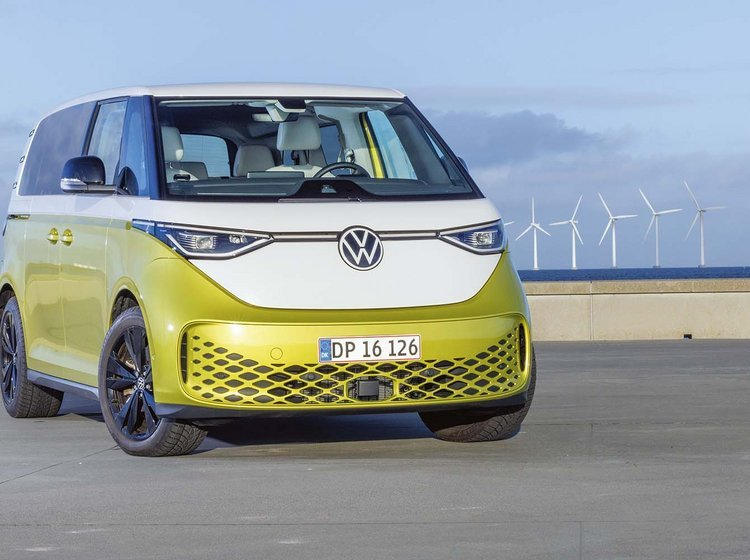
Hmm. Great. While true, it’s not exactly riveting. What won my heart about the Buzz is the fact that it’s a revitalisation of the old volkswagen T1/T2. Colloquially know as the hippie van or the VW bus. In Denmark, where I’m from, it’s also called “folkevognsrugbrødet” which is almost impossible to translate. “Folkevogn” is the Danish translation of the German word “volkswagen” which roughly translated means “people’s van” – while “rugbrød” is a type of dark heavy bread enjoyed in Denmark. It’s heavy, cheap and keeps you going through hard work. Similarly, when you’re biking, you’re using your “rugbrødsmotor” or your “rugbrødsengine” to power the bike. Put all that together and you get a car that’s like a people’s van that keeps on going. A work horse accessible to all.
But I digress, besides the history, it’s beautiful with it’s big smiley front, large logo and welcoming headlights. It’s also functional, spacious and just all around joyful to drive. I’m not trying to sell you this car but I want to put my enthusiasm down on paper for all to see.
Where does Vanlife come into all this?
Yes. Vanlife. It’s because I want to use this car as both our primary (and only) vehicle in the family and as an every day adventure facilitator. It’s already set up for this from Volkswagens side and although it’s not a campervan per se, it’s definitely usable in that domain.
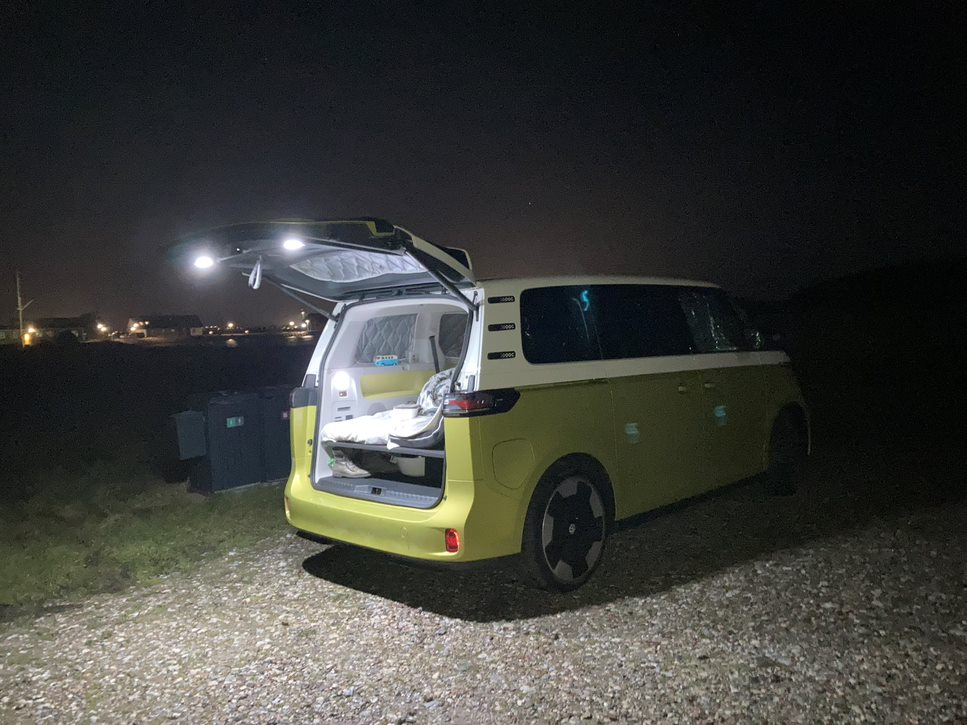
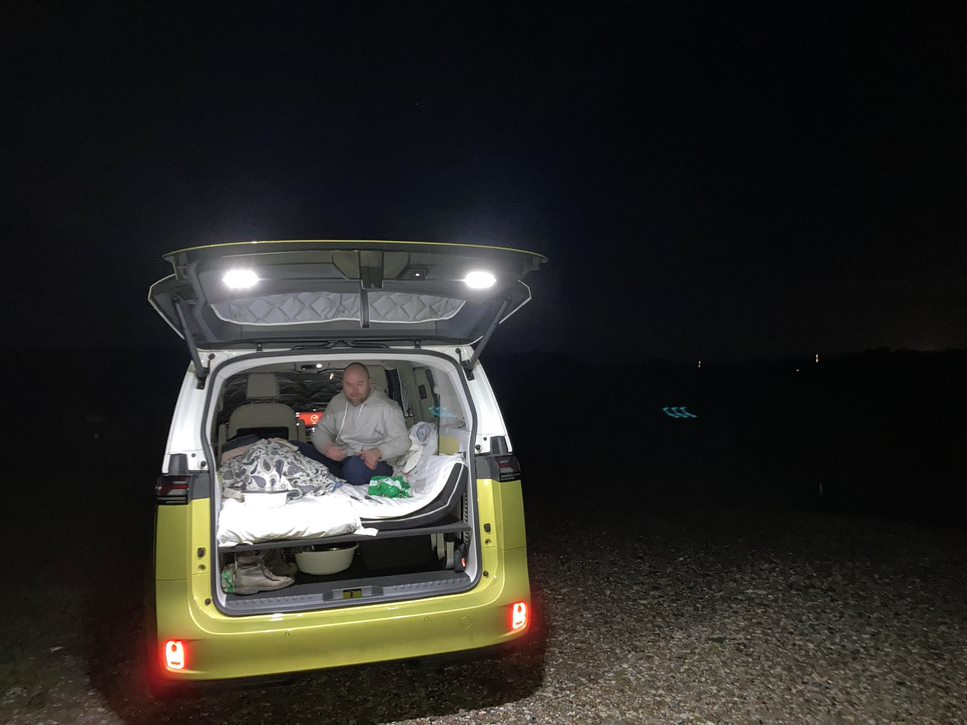
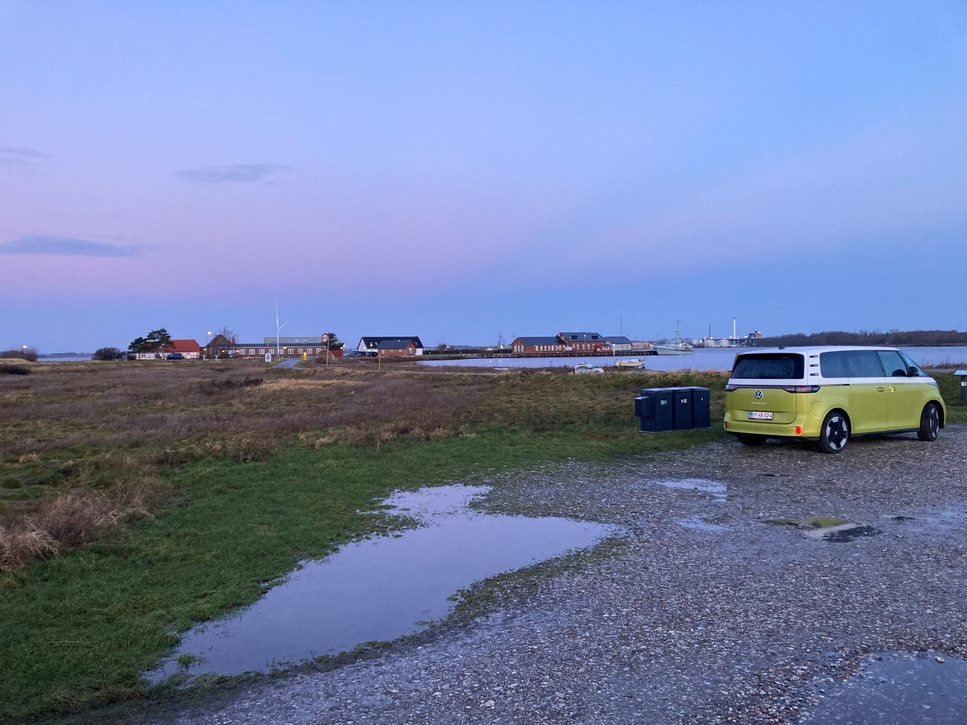
In fact, all though it’s winter and negative degrees (celcius) here in Denmark. I’ve already taken out the van to wild camp (camping for free on random parking lots etc).
It worked quite well. Being electric it gives you lots of power to enjoy. We spent around 10% battery keeping it warm all night.
We haven’t figured out all the small details. As you see, the mattresses are 140cm wide, while the car is only 120cm so they don’t totally fit. We also need to buy camping gear. We have a Jackery 1000W Explorer pro battery that can run an electric stove and some other minor gear. It all fits under the split seat so that you have a lot of free space in the main “sleeping cabin”. However, we still need maybe a fridge, some boxes to compartmentalise stuff, an awning on the side, some chairs and a table etc. Whatever it takes.
However, as this is also going to be used as a normal every day car, we’re not going for a full rebuild or permanent installations.
What’s next?
More adventures, more gear, more stories and anecdotes, and more posts right here on worldwidewinther.com
At around 20:00 (8pm) we arrived at Tangier port. With a beatiful view to the oldest part of the town, Medina, and the walls surrounding it, we entered Africa. Immediately we were approached by a seemingly friendly guy that wanted to show us around and help us find a hostel or a place to stay. The prizes he quoted seemed reasonable compared to what we could find on the internet but as we didn’t want to book the first the best thing we got offered, we decided to say no. He then offered us to buy some hash instead which we also politely refused.
We walked for about 5 mins out of the harbor (about 5 guys asked us if we wanted a taxi) before another guy told us not to go the direction we were heading because it was dangerous. We decided to follow his advice and go another way. He followed us and started talking to us and of course he wanted to show us a hotel he knew (very good price – best price and good beds) – this guy, however, didn’t stop following us until we gave him some money. It turned out that this was neither the first nor the last time that “helpful” locals offered us their help. Later that evening after we had found a hostel we walked around the town for a bit and a guy offered to help us. A “no” and “please leave” didn’t deter him and after we told him more and more sternly to leave (and gave him some money) he left us with a “Fuck you!” as his last words. We then had a tea and pondered upon our recent experience.
For another hour we walked around Medina and looked at the people and the surroundings. This place is like taken directly out of a James Bond movie with extremely narrow streets and odd buildings. People hanging on every street corner and small shops selling all kinds of things and trinkets. It was unlike anything I’ve ever seen before and something worth experiencing! It was very easy to get lost and we did so too a couple of times which resulted in us ending up in dead ends of various more or less illuminated alleys. Despite dark dead end alleys it all seemed safe though.
I could see James bond jumping between these buildings, chasing a perp
Second day in Tangier
We had a delicious breakfast at the hostel and ventured out. People kept approaching us to help but we got better at saying no right away. Telling them we knew what we wanted and where we were going helped, politeness and no thank you didn’t. We walked around and outside Medina to see if we could rent a scooter but with no luck.
Instead we got to see alot of the town and some nice views over the Mediterranean Sea and we found a local watering hole with a very (genuinely) friendly bartender who talked to us and explained things while we had a beer. He also kept bringing us tapas of various kinds, until we were completely full – for free! He was indeed very friendly and made me restore faith in people not wanting something for their help 🙂
We had a local beer called Casablanca
He also told us where to get a Shisha and surprisingly we found the place about 10 mins away very easily.
Shisha and Tea
I am now back in the hostel and it was actually a very nice day. Tomorrow we plan on going to see Chefchaouen up in the nearby mountains which is apparently a very nice place with excellent views!
We rented a car for a few days, bought a tent in Walmart and went free camping. Free camping is free camping on public land.
Can you do it on Maui? Absolutely. Is it legal? meeeeeehh. Ish.
It’s tolerated and if you stick to a few rules, you’ll be fine. Ask me in comments if you want advice.
This is the view when we wake up in the tent – I mean, holy smokes. The night before we actually very seriously feared that the tide would swallow our tent!
When you wake up, you’re in the middle of the obscenely beautiful landscape that is Maui. You’ll be enjoying this view all day and all the beaches are spectacular!
So what are you waiting for? Hawaii doesn’t have to be so expensive.
Contact me on your favourite social media or here in the comments if you want advice or just want to chat
We started directly from after our respective Christmas lunches with our families. Said goodbye to our parents and to all the people that told us this was a bad idea and why didn’t we just fly?
At 20:30 (8.30pm) we had made it across the ferry to Germany. I took the first leg and before we knew it, going 180km/t on the German autobahn, we had made it to Liege, Belgium. The gas mileage dropped from 18km/L to about 12km/l but the average speed was above 150km/t according to the car computer.
Belgium had some of the most empty roads I’ve ever seen. Not a car going the opposite direction for up towards 10 mins and lots of empty parking lots. Didn’t see a rest stop or a gas station either for several 100 kms but luckily we had enough gas. At 04:30 (am) we hit Luxembourg and had a local waffle and beer (Bofferding beer) and I went to bed on the back seat.
Waffles and Beer at a rest stop in Luxembourg
When I woke up about 9 hours later we were on the border to spain. We had passed France while I slept and from the sporadic conversations I had heard from the front seat, French drivers are really bad drivers. Mileage was now up to 18km/l due to the more moderate average speed of 120km/t
I took over driving again and 8 hours later at 22:00 (10pm) we checked in to a hostel in Alicante, Spain.
In Alicante, we had the most awesome tapas and beer and Sangria. All tapas was 90 eurocents and all beers were 30 cents. The waiters were running around with beer and tapas of various kinds, chicken, squid, anchovies, ham, sausages etc. and whenever you wanted some you just grabbed it from the plate. In the end they counted the empty glasses and the empty plates to get the final bill. Such a simply concept and such brilliant food for so little money. Why can’t we have this in Denmark!?
To sum up : in about 24 hours we had driven 2800km non-stop across 6 countries and had made it from the north of Europe to the Mediterranean Sea. Only about 6 hours driving and a ferry from Tarifa to Tangier and we are in Africa!
In France they are very zealous about signs. I think I understand that this is the wrong way
The evening before (December 30.) we had decided to make it to Madrid for New years eve which meant we had to catch an “early” 11am ferry from Tangier. On a sunny day, around 10:55, three sweaty white guys graciously boarded the ferry across the Mediterranean to Tarifa – we just barely made it! Except we were in Africa and the ferry was on african time. 45 minutes delayed on a 45 minute sail meant that a little over 1½ hours later + 1 hour because of time zone differences we were reunited with our car in Spain.
Driving all day since the drive was a little longer than anticipated, we arrived at Sungate One Hostel right in the middle of Madrid around 9pm. Immediately we were offered free food and the smiles of about 30 other people celebrating new years eve. We dropped our stuff, took a shower and immediately joined. The evening went as New Years evenings do although one peculiar thing is worth mentioning. In Spain, apparently, they all eat 12 grapes – one for each month of the year. When the clock strikes midnight and for every strike after, you eat a grape. That’s 12 grapes in 12 seconds. Interesting tradition and nobody seemed to be able to do it – the strikes were too fast and there were too many people to even hear them.
My friend Uran is wearing his suit and Fes (the hat) aswell as holding the grapes
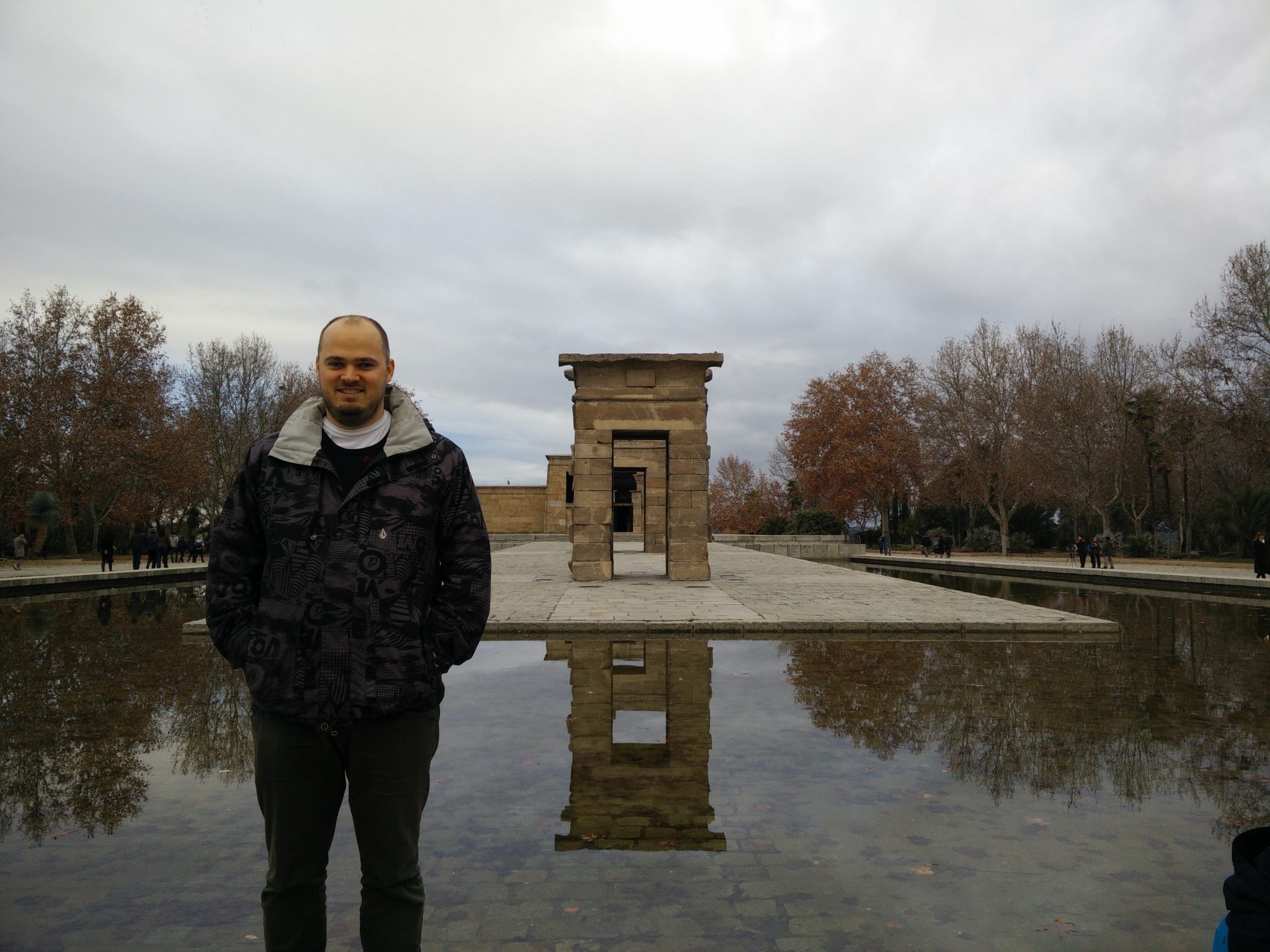
We decided to stay in Madrid all of January the 1st to do some quick sightseeing and start our journey home well rested the 2nd. We saw the egyptian Temple of Debod which was given as a gift from the Egyptians as gratitude for the help Spain had given in providing the preservation of other Egyptian temples such as the Abu Simbel Temple. Personally, I don’t understand how you can just “move” a temple. If it’s built again then, that’s kind of cheating isn’t it? Is it just the same rocks put together using modern cranes etc, or do they actually build it the same way? In either case I’ve never understood the concept of moving old buildings like that even if I’ve seen it numerous times before. And that’s even before mentioning the practicalities of it all – even with modern tools it’s quite the puzzle to make all the bricks go together the right way and would probably be impossible without some kind of mending to them.
Temple of Debod
We also saw the Royal Palace of Madrid. It is an astonishing piece of work and very visually pleasing. As a fun fact, it’s 135000 m^2. That’s right. That’s 3,418 rooms!!! The palace was built and extended over several hundred years . It’s so large that the current royal family doesn’t live in it. They live in the more modest Palacio de la Zarzuela.
Royal palace of Madrid seen from away
Royal palace of Madrid seen from the front
The morning of January 2nd we started driving home non-stop and around 14:00 (2pm) the next day we made it home.
We took the backroads in Spain to avoid road tolls and to enjoy the amazing landscape.
We rushed over France and the shitty french drivers who don’t know how to keep right. Although one thing to notice is that we passed through Paris and saw the Eiffel Tower while driving by!
Belgium was as empty as on the way out. No cars. Long straight very lit roads with a ghoulish yellow light. Easy to drive but it’s not an interesting trip
When we hit Holland the lights of Belgium stopped. It was pitchblack and the street signs vanished. Roadworks and poor signing made Holland very hard to drive in, if only for 100km.
Back in Germany and the autobahn it was smooth sailing if only at slower speeds due to night, snow, hail and rain.
The total trip was 6666km’s. It’s the most intense road tripping I’ve done so far and I’ve driven from Troy, New York to Las vegas and back over thanksgiving.
The night of the 2nd I slept for 13 hours. I was tired. It was a good trip.
We use cookies on our website to give you the most relevant experience by remembering your preferences and repeat visits. By clicking “Accept”, you consent to the use of ALL the cookies.
This website uses cookies to improve your experience while you navigate through the website. Out of these, the cookies that are categorized as necessary are stored on your browser as they are essential for the working of basic functionalities of the website. We also use third-party cookies that help us analyze and understand how you use this website. These cookies will be stored in your browser only with your consent. You also have the option to opt-out of these cookies. But opting out of some of these cookies may affect your browsing experience.
Necessary cookies are absolutely essential for the website to function properly. These cookies ensure basic functionalities and security features of the website, anonymously.
Cookie
Duration
Description
cookielawinfo-checkbox-analytics
11 months
This cookie is set by GDPR Cookie Consent plugin. The cookie is used to store the user consent for the cookies in the category "Analytics".
cookielawinfo-checkbox-functional
11 months
The cookie is set by GDPR cookie consent to record the user consent for the cookies in the category "Functional".
cookielawinfo-checkbox-necessary
11 months
This cookie is set by GDPR Cookie Consent plugin. The cookies is used to store the user consent for the cookies in the category "Necessary".
cookielawinfo-checkbox-others
11 months
This cookie is set by GDPR Cookie Consent plugin. The cookie is used to store the user consent for the cookies in the category "Other.
cookielawinfo-checkbox-performance
11 months
This cookie is set by GDPR Cookie Consent plugin. The cookie is used to store the user consent for the cookies in the category "Performance".
viewed_cookie_policy
11 months
The cookie is set by the GDPR Cookie Consent plugin and is used to store whether or not user has consented to the use of cookies. It does not store any personal data.
Functional cookies help to perform certain functionalities like sharing the content of the website on social media platforms, collect feedbacks, and other third-party features.
Performance cookies are used to understand and analyze the key performance indexes of the website which helps in delivering a better user experience for the visitors.
Analytical cookies are used to understand how visitors interact with the website. These cookies help provide information on metrics the number of visitors, bounce rate, traffic source, etc.
Advertisement cookies are used to provide visitors with relevant ads and marketing campaigns. These cookies track visitors across websites and collect information to provide customized ads.